BE PROUDLY SATANIC!
Why If You're A Satanist, You Should Say So

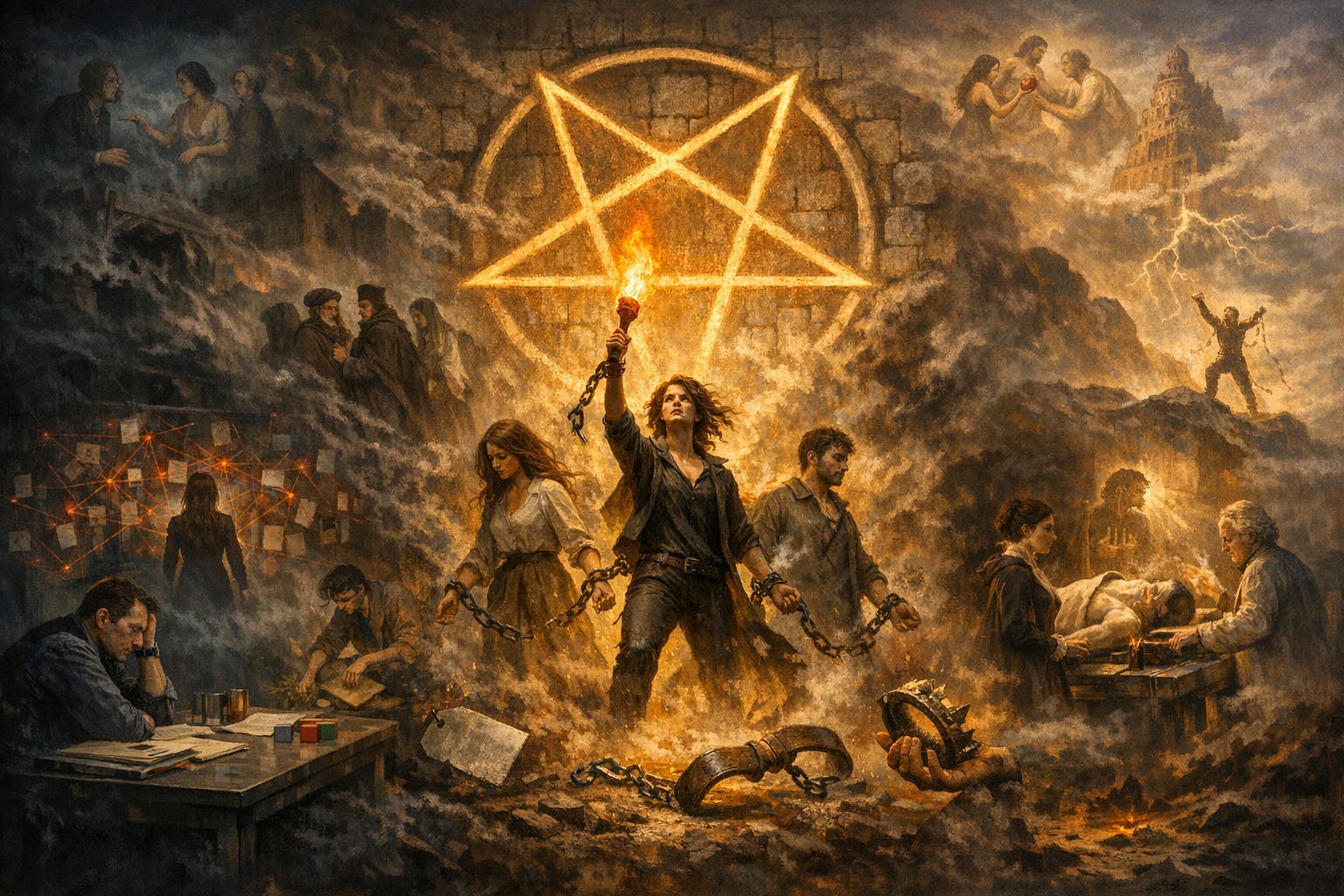
Satanism should be salvaged from out of the swamp of late-twentieth-century hysteria and twenty-first-century conspiracy theology and returned to its proper literary and philosophical place as a banner of spiritual and meta-political rebellion on behalf of enlightenment, liberty, and individualism. Such a salvage operation needs to begin with an examination of the Satanic Panic, not as a quaint episode of media excess, but as a modern witch hunt in which juridical institutions, therapeutic ideology, and mass culture conspired to manufacture demons in the absence of evidence. The instructive point is not merely that these cases collapsed, but that their collapse changes nothing about the structure that generated them – because what was being prosecuted was not a crime, but a myth that modernity still requires to narrate its anxieties.
From there I move to the contemporary afterlife of the same pathology, namely the “globalist Satanist cabal” mythology in its Podesta–QAnon variants. This is not an exposure of hidden power; it is the replacement of religion with paranoia. It is a theodicy for an age that can no longer tolerate the banality and structural impersonality of modern power – so it converts complexity into demonology, institutions into intention, history into a crime scene authored by metaphysical evil. In doing so, it exploits the reality of child abuse and trafficking by transmuting them into spectacle, thereby shielding real perpetrators behind a smokescreen of myth.
I then widen the frame to show that none of this is new. The Inquisition and the witch hunts were not medieval “aberrations,” but the consistent application of a theological logic that made certain humans disposable, above all women – whose knowledge, autonomy, erotic sovereignty, and authority had to be demonized in order to be exterminated. What this shows us is that Western history did not chiefly suffer from hidden Satanists; it suffered from sanctified institutions that practiced ritualized cruelty in public, under legal and doctrinal cover, while later projecting their own crimes outward onto imaginary enemies.
Only after this demolition of the hysterical image do I reconstruct Satanism as what it has, at its deepest level, always been: the Counter-Tradition – an adversarial posture toward any so-called divine order that functions as a system of hierarchy, obedience, and moral blackmail. The figure of Belial becomes decisive precisely because it names a stance rather than an entity: without value (in the sense of refusing pre-inscribed cosmic standards), without yoke (refusing binding as religion), without god (denying any transcendent sovereign an inherent right to rule the human project). This is the Promethean rebellion at the root of Western myth, later deformed into “evil” by the very regimes of meaning it threatened.
Finally, I trace the migration of this adversarial archetype into Romanticism and beyond –Milton, Blake, Shelley, Gothic literature, anarchism – where Satan becomes the emblem of intellectual insurrection, technological emancipation, and the revolt against patriarchal metaphysics. The culminating point is Percy Shelley’s Luciferian Prometheus and Mary Shelley’s Frankenstein: not warnings against knowledge as such, but diagnoses of what incomplete Prometheanism produces – creators who seize the power of gods while refusing the obligations of creation. We need to understand why societies keep inventing demons – and why the oldest name for human emancipation, in the languages of obedience, is always “the adversary.”
The 1980s Satanic Panic
The Satanic Panic of the 1980s was not a series of isolated judicial errors; it was a civilizational psychosis. What makes its most infamous cases so philosophically instructive is not merely that they were false, but that they were believed with a fervor normally reserved for religious revelation. In each of these prosecutions, the absence of evidence did not weaken conviction; it intensified it. The more implausible the accusations became, the more they were taken as proof of the enemy’s cunning.
The McMartin Preschool case stands as the epicenter of this delirium. What began as a single, incoherent accusation by a disturbed parent metastasized into the longest and costliest criminal trial in American history. Children were subjected to months of coercive, leading, and frankly abusive interrogations, until they began to narrate a cosmology rather than a crime: secret tunnels beneath the school that did not exist, teachers who flew through the air, orgies, animal sacrifices, and rituals conducted in churches and cemeteries. No physical evidence was ever found. No tunnels. No remains. No corroboration. After seven years, every charge collapsed. But by then, the case had already served its function. It had taught a generation of Americans that fantasy, if repeated with enough moral certainty, could acquire the authority of law.
The Kern County cases in California were even more grotesque in their social consequences. Here, dozens of adults were accused of participating in vast intergenerational Satanic conspiracies involving ritual abuse, pornography rings, and cult breeding programs. Children were systematically coached by social workers to produce ever more elaborate testimonies, until entire extended families were torn apart. Some defendants were sentenced to life in prison on the basis of stories that later collapsed under minimal scrutiny. Years later, appeals courts acknowledged that the interviews themselves had manufactured the accusations. The state quietly released many of the convicted. No cult was ever found. But the damage – to families, to jurisprudence, to the credibility of child protection itself – was irreversible.
In Jordan, Minnesota, the panic assumed a form that was almost parodic. Here, nearly two dozen residents were accused of belonging to a secret Satanic network that allegedly abused scores of children in basements, barns, and forests. The accusations multiplied geometrically, not because new evidence emerged, but because the investigative techniques rewarded imagination. Children learned very quickly which kinds of stories satisfied adults. When the cases finally reached court, the narratives collapsed under the weight of their own contradictions. Prosecutors dropped the charges. But the town had already been transformed into a moral crime scene, a rural Salem in which suspicion became the only stable form of social knowledge.
The Fells Acres Day School case in Massachusetts illustrates the conversion of therapeutic ideology into prosecutorial machinery as another aspect of the Satanic Panic. Here again, children were guided into describing rituals, costumes, secret rooms, and ceremonies that no investigation could ever substantiate. Several defendants were convicted and served years in prison before appellate courts overturned the verdicts, acknowledging that the interviews had been irreparably contaminated. The exonerations came quietly. The accusations had come with fanfare. This asymmetry is not accidental. Modern societies, no less than medieval ones, crave the theater of accusation more than the banality of correction.
The Little Rascals Daycare case in North Carolina marks the terminal stage of the hysteria, when the pattern had already become unmistakable. Children were interviewed hundreds of times over several years, until they produced a baroque mythology of secret tunnels, magic mirrors, and ritual murders. Physical examinations were misrepresented. Medical testimony was distorted. After years of litigation, every conviction was overturned. Judges concluded that the case had been built on suggestion, coercion, and fantasy. By this point, the structure of the panic was fully visible. It did not require Satanists. It required only three ingredients: suggestible children, ideologically primed professionals, and a culture prepared to believe that evil must be both invisible and omnipresent.
What unites these cases is not merely their falsity, but their symbolic function. None of them uncovered a single organized Satanic network. None produced a single body, a single cult site, a single financial trail, a single corroborated ritual. Yet they were believed with absolute confidence because they answered a metaphysical need. In a society undergoing rapid secularization, sexual liberalization, and the erosion of patriarchal authority, Satan returned not as a theological figure, but as a forensic hypothesis. The Devil was no longer in hell. He was in the daycare center.
From a Counter-Traditional perspective, the Satanic Panic is not an aberration. It is a recurrent structure that produced witch hunts, heresy trials, and inquisitions. What changes is not the psychology, but the vocabulary. In the absence of devils with horns, we invent cult networks with tunnels. The panic was not about protecting children. It was about protecting a collapsing moral order by projecting its disintegration onto an imaginary enemy. The final irony is that the Panic did not expose Satanists. It exposed the fragility of rational modernity itself. It revealed how easily enlightenment collapses into superstition when fear is given institutional authority, and it demonstrated, with chilling clarity, that societies do not need real demons to commit real injustices. They need only the belief that demons must exist somewhere – and the willingness to create them when they cannot be found.
The Supposedly Satanic Globalist Cabal
Now let us move from the Satanic panic on a local level to hysteria over a supposedly “Satanic” global cabal, devoted to bringing about the One World Order of the Antichrist through a pizza gate to occult realms. What we are witnessing in the Podesta–QAnon – “global elite Satanist” mythology is not an exposure of hidden power, but the pathological afterlife of a theological imagination that can no longer admit its own obsolescence. These accusations are not grounded in evidence. They are, at least subconsciously, crafted to preserve a cosmology that has lost its god.
There is not a single verified datum demonstrating that John Podesta, or any comparable political or financial figure, is a “Satanist” in any meaningful sense of that word. There is not a single substantiated case of an elite-run Satanic ritual abuse network. No victims. No bodies. No cult infrastructure. No financial trails. No internal documents. No corroborated witnesses. What exists instead is a closed hermeneutic system in which absence of evidence is reinterpreted as proof of omnipotent concealment. This is not investigation. It is a theodicy for the age of conspiracy.
The psychology here is transparent. These people are not defending children. They are defending a metaphysical worldview that can no longer account for history. In a universe devoid of Divine Providence, power becomes intolerable unless it is demonized. If elites are corrupt, they cannot merely be venal or self-interested. They must be metaphysically evil. If institutions fail, it cannot be because of structural complexity or systemic inertia. It must be because Satan is in charge.
This is the same structure that produced witch hunts, blood libels, and the Satanic Panic. The names change. The narrative does not. A hidden cabal. Secret rituals. Child sacrifice. Total infiltration. A coming apocalypse. A savior figure who will expose them. It is medieval demonology rewritten in the language of email servers and intelligence agencies. The only thing modern about it is the technological medium through which the message spreads.
What makes this particularly grotesque is the cynical misuse of real suffering. Child abuse is real. Trafficking is real. Institutional cover-ups are real. There is some evidence that elements of the American Deep State are involved in this, including the Central Intelligence Agency that is not supposed to be operating domestically. But these real abuses are not properly investigated. They are displaced and converted into mythology, thereby protecting actual perpetrators behind a smokescreen of fantasy. When everything wicked is “Satanic,” no one is really held accountable.
Even more revealing is their total ignorance of what Satanism really is. Historically, Satanism has nothing to do with child sacrifice or the abuse of animals – both of which are actually prevalent in the Abrahamic religious traditions to which Satanism has stood opposed as a Counter-Tradition. As we shall see, the embrace of Satan is a symbolic and philosophical tradition of rebellion against theological tyranny, clerical authority, and moral heteronomy. From Milton to Blake, from Shelley to Bakunin, Satan is the emblem of intellectual insurrection, not ritual murder. The people accused of being Satanists are not too evil to be Satanists. They are too banal.
What these conspiracy theorists are really attacking is not Satanism, but modernity itself. Secular governance, bureaucratic power, globalization, technocracy, financial abstraction, sexual liberalization, the erosion of patriarchal religion – these are the real objects of their terror. But these phenomena are too complex to be understood sociologically, so they are translated into demonology. The “New World Order” is not a cabal. It is the name given by frightened minds, who have never actually read H.G. Wells – who coined the term – to the impersonal dynamics of modern power. If instead what they mean by a “New World Order” is the “New Order of the Ages” or Novus Ordo Seclorum on the Great Seal of the United States (together with the pyramid and the All Seeing Eye in the capstone), then they are so ignorant as to confuse the Masonic Deism of the Founding Fathers of America with the Satanism romantically embraced by others of the same era, such as Lord Byron and Percy Shelley – to whom we will turn soon.
The Inquisition and the Witch Hunts
What the modern mind is often reluctant to confront is that the Inquisition and the witch persecutions were not aberrations of a barbaric past, but the systematic application of a theological logic that had already decided, in advance, that certain kinds of human beings were ontologically disposable. Heresy was not an error to be corrected. It was a stain to be burned out of the world. The bodies through which this logic most efficiently operated were the bodies of women.
The Cathars of Occitan stand at the beginning of this long exterminatory arc. They were a Gnostic Christian counter-church, ascetic at the highest level, literate, and intellectually formidable, whose crime was to deny the moral legitimacy of the Catholic hierarchy. They rejected the sacramental monopoly of Rome, the wealth of the clergy, and the idea that salvation required submission to an institutional church. For this, an entire culture was annihilated on the charge of worshipping “Lucifer” (which the Cathars equated with the Gnostic Christ). The Albigensian Crusade was not a campaign of conversion but of eradication. Cities were put to the sword indiscriminately. Men, women, and children were slaughtered en masse. When asked how to distinguish heretics from the faithful, a papal legate famously replied: “kill them all, God will know His own.” This was not fanaticism in a moment of frenzy. It was policy.
What followed was the invention of a juridical machine designed to make extermination permanent. The Inquisition did not seek truth. It sought confession. Guilt was presumed. Silence was evidence. Denial was proof of obstinacy. Torture was not an excess; it was a sacrament of the system. Strappado, the rack, the iron boot, sleep deprivation, starvation, sexual humiliation – these were routine instruments of spiritual purification. Confessions were extracted not to establish facts, but to generate narratives that justified the institution’s own existence. Once a category of enemy is created, the apparatus that hunts it can never be dismantled. It can only change its targets.
When the focus shifted from organized heresy to witchcraft, the logic became even more nakedly misogynistic. The witch was not primarily a practitioner of magic, although those targeted likely cultivated latent human psychic abilities at a higher level than average – or possessed what Charles Fort called “wild talents” unbound by belief in religious orthodoxy. The witch was a woman who exceeded her allotted obedient role, with her punishment having been codified in the Biblical injunction that “thou shalt not suffer a witch to live.” (Exodus 22:18) A widow with property. A healer with knowledge. A midwife with authority over birth. An old woman without male protection. A young woman who refused submission. The demonological manuals make this explicit. Women are accused not because they are powerful, but because they are deemed naturally defective: more lustful, more deceitful, more susceptible to the Devil. Theology provides the metaphysics. Misogyny provides the motive.
The trials were juridical theater. Accusations were encouraged. Children were coached. Neighbors were incentivized to denounce. Spectral evidence was admitted. Torture was used to elicit ever more elaborate confessions: sabbaths, orgies, infanticide, cannibalism, flight through the air. The accused learned very quickly what kind of stories satisfied the court. To confess was to die. To refuse was to die more slowly. Burning at the stake was not execution, it was a pedagogical and public demonstration of what happens to women who do not remain in their place.
Hundreds of thousands were imprisoned, tortured, exiled, or killed across Europe. In some regions, entire female populations were decimated. Villages lost their healers, their midwives, their elders. Knowledge was destroyed along with bodies. What modern historians call the witch hunts were in fact a long counter-insurgency against female autonomy, popular medicine, erotic independence, and any form of spiritual authority not mediated by the Church.
This same institution that claimed to protect souls was simultaneously constructing one of the most pervasive systems of child abuse in human history. For centuries, children were placed in the absolute power of celibate men who were answerable only to their own hierarchy. Sexual violence was not incidental. It was structural. It was enabled by secrecy, sanctified by doctrine, and protected by institutional immunity. When victims spoke, they were silenced. When evidence emerged, it was buried. When crimes were proven, perpetrators were transferred, not punished.
The cruelty of this history is not merely physical. It is epistemic. The Church did not only torture bodies. It colonized memory. It rewrote archives. It canonized executioners. It transformed victims into sinners and murder into righteousness. Even today, the scale of clerical abuse is minimized, relativized, or deflected, while imaginary conspiracies about “Satanists” circulate freely among those who refuse to examine the crimes of their own tradition.
What unites the Cathar genocide, the witch burnings, the Inquisition, and clerical child abuse is not belief, but power. A system that claims divine authority cannot tolerate rival sources of meaning. It cannot tolerate female knowledge. It cannot tolerate unauthorized sexuality. It cannot tolerate dissent. When such a system is challenged, it does not argue. It exterminates. The final obscenity is that the same civilization that burned women alive for imaginary crimes – and destroyed the minds of children that it abused – now accuses modern society of harboring hidden Satanic cults, while refusing to confront the documented crimes of its own institutions. The real ritual abuse in Western history was not conducted in secret basements by imaginary cults. It was conducted in courts, convents, prisons, and churches, with legal sanction, theological justification, and the applause of the faithful.
Satanism as the Counter-Tradition
If we are going to cease treating “Satanism” as a late-modern pathology – an adolescent masquerade of rebellion, or a hysterical Christian projection – then we must restore it to its true place in intellectual history: at the very origin of the Counter-Tradition itself. What later ages baptized as “Satanic” is not a corruption of primordial wisdom, but the earliest conscious revolt against a divinely sanctioned caste order. The Counter-Tradition is is the Promethean uprising against a cosmic hierarchy in which obedience is moralized, a feudal and slave-driving inequality is sacralized, and humanity is trained to confuse submission with sanctity. In this sense, Counter-Traditionalism – including the Indo-Aryan Left-Hand Path – is the oldest and most authentic form of Satanism.
“Satan” in Hebrew is not a personal name but a functional designation: the adversary, the one who stands in opposition to a supposedly divine order. This is why the concept of “Belial” is so philosophically decisive, and why clerical consciousness had to deform it into either a demonic proper name or a synonym for moral worthlessness. In its older and more revealing usage, Belial is not an entity at all, but a stance toward existence articulated through a remarkable semantic triad. Built on beli–, “without,” and followed by a term whose ambiguity is itself meaningful (ya’al, al, ya’ol, or ya’el), Belial yields three inseparable meanings: without value, without yoke, without god. These are not rhetorical flourishes; they define a metaphysical position. To be “without value” is not to be worthless, but to reject the very premise that the cosmos comes pre-inscribed with moral standards affixed by a transcendent legislator. To be “without yoke” is to refuse binding, harnessing, religion itself, since religion (from religio or religere) literally means “binding.” To be “without god” is not merely to blaspheme, but to deny that any transcendent sovereign has an inherent right to rule the human project. Taken together in all three of its polyvalent connotations, “Belial” names the original posture of emancipation: godless, unbound, and without any objective moral law imposed from above.
It is precisely this posture that, in his writings about Atlantis, Edgar Cayce cannot interpret except as degeneracy. For all his mediumistic pretensions, Cayce remains a metaphysical schoolmaster, incapable of imagining that the adversary might be the liberator and that the divine order might be the oldest system of spiritualized slavery. Even when he preserves the outline of a Promethean faction that awakens from inherited hierarchies and begins to think for itself, he can narrate that awakening only as a fall. The “sons of Belial” become, in his hands, not the first existential rebels, but the first moral deviants. His cosmology cannot tolerate the possibility that the true crime is not rebellion against God, but fidelity to Him.
Rudolf Steiner performs a more sophisticated, and therefore more dangerous, version of the same operation. By labeling the rebel Atlanteans “Ahrimanic,” he commits a philological and metaphysical error whose consequences reverberate through his entire anthroposophical system. His Christological dramaturgy requires a tripartite stage: Lucifer above, Ahriman below, and Christ as mediating savior between two symmetrical evils. In this schema, Lucifer is an excessive spiritualization, Ahriman an excessive materialization, and Christ the golden mean who rescues humanity from being torn apart between them. This is not cosmology; it is theological theater.
In the Iranian matrix, Ahriman is not a demon of matter, nor the lord of some chthonic anti-spirit. Ahriman is the name for a constrictive mentality, a spirit of arrest and inhibition, set in polarity with Spenta Mainyu, the progressive and bounteous spirit of innovation. The fundamental conflict is not between spirit and matter, nor between heaven and earth, but between creative augmentation and stagnant fixation. The Promethean gesture belongs unequivocally with Spenta Mainyu, because it is precisely the theft of fire – of technē, of forbidden knowledge – against a cosmic order that seeks to keep mortals bound to inherited roles and sanctified necessity. Moreover, when viewed through the lens of Zarathustra’s thinking, a supreme instantiation of the Ahrimanic Lie promulgated by the Daevas (the gods worshipped by Christians and Muslims as “angels”) is the Abrahamic Lord that is both Yahweh who sent Jesus and Allah who revealed the Quran to Muhammad. The teaching of Zarathustra is “Satanic” from both an Abrahamic perspective, and also from a classic Vedic perspective – since Zarathustra demonizes the gods worshipped by the Hindus and uses the demonized Hindu term for the titans, namely Ashuras – or Ahuras in Old Persian and Avestan – to describe its divine principles and emissaries.
Steiner’s deeper error is his retrojection of a late Gnostic dualism onto Zarathustra. The Gathic vision does not despise embodiment, nor does it dream of salvation from matter through a transcendent redeemer. The earth is not a prison; it is a field of engineering, a realm to be cultivated into paradise through progressive creativity. The metaphysical tug-of-war that Steiner installs between two quasi-divine antagonists is not primordial wisdom but a much later infection, one that smuggles into Iranian thought the very dualism that Zarathustra’s vision resists.
Once this is seen, the strategic function of Steiner’s distinction between “Luciferian” and “Ahrimanic” becomes transparent. It is a mythological divide-and-conquer operation. It fractures the Promethean insurgency into a false vertical polarity – too lofty versus too low, too spiritual versus too material – so that the only permissible reconciliation is submission to Christ as a mediating savior and the priesthood that claims to administer him. The older Iranian polarity is not metaphysical but political-existential: between progressive creation and constrictive domination. This progressive creation is considered Satanic by Abrahamic adherents, especially by Muslims who literally categorize bid’ah or “innovation” as one of the principal acts of heresy and apostasy.
This is why the Counter-Tradition is Satanic in the only sense that matters. It is adversarial toward a so-called divine order that has always functioned as a control system of hierarchy, obedience, and spiritual blackmail. Belial is its oldest Abrahamic name precisely because it is not a demon to be feared, but a declaration to be understood: no objective moral law imposed from above, no cosmic yoke disguised as religion, and no god entitled to rule over the human future.
If one strips away the sensationalism that later centuries layered onto the figure of Satan, what emerges is not a cultic pathology but a continuous counter-history of rebellion against a very specific theological and political order. The Satanist perspective, as it gradually takes form in Western literature, is not born in the nineteenth century, nor with occult fraternities, but in the earliest strata of the Biblical imagination itself. From the opening pages of Genesis, the drama is not one of moral failure but of political insubordination. The serpent does not tempt humanity into vice; he discloses a forbidden horizon of discernment. The crime for which humanity is expelled from Eden is not lust or disobedience, but the threat of emancipation: the possibility that a race of servants might actualize capacities that place them on the same ontological plane as their masters. The so-called Fall is the first workers’ revolt in sacred history.
This logic is reiterated, with even greater clarity, in the episodes that follow. The revolt of the Watchers, as preserved in the Book of Enoch, is not a descent into depravity but a civilizational insurrection. Angels violate the heavenly caste order by taking mortal wives and teaching them the arts, the sciences, the crafts of beautification, reproduction, astronomy, and metallurgy. Knowledge is erotic, and eros is technological. A hybrid civilization arises that no longer reveres the Lord and no longer accepts nature as a fixed creation, but modifies it through technē. The response is extermination by flood. The lesson is unambiguous: whenever knowledge threatens hierarchy, apocalypse follows.
The same pattern governs the story of Babel. A unified humanity, speaking one language and pursuing a single technical project, attempts to build a stairway to heaven. The divine reaction is not benevolence but terror. If they remain united, nothing will be impossible to them. So the tower is destroyed, languages are multiplied, and war is instituted as a permanent condition of the human species. This is the first recorded instance of divide and conquer as a theological strategy. In this light, Satan is not a single or singular enemy of God, but a name that is symbolically and retroactively given to every force that resists a divine monopoly on power. It is this subterranean reading of Scripture that re-emerges, centuries later, in the great Romantic rehabilitation of Satan.
Satan as a Romantic Symbol of Rebellion
When John Milton grants Lucifer tragic grandeur in his Paradise Lost, when William Blake proclaims the marriage of heaven and hell, when Percy and Mary Shelley and Lord Byron elevate the rebel angel into a symbol of human emancipation, they are not inventing a new mythology. They are restoring the suppressed meaning of an ancient one. Satan becomes a defiant brand for the archetype of the intellectual insurgent, the figure who refuses to sanctify injustice simply because it claims celestial authority. In these poets, the Devil is no longer the seducer into vice, but the awakener of conscience against tyranny.
What makes this Romantic Satanism historically decisive is that it explicitly links rebellion against God with rebellion against patriarchy. The Eden narrative had already made this connection. Eve’s crime is not sensuality but pedagogy. She teaches. From that moment onward, female instruction becomes suspect, and female knowledge becomes diabolical. The prohibition against women teaching, the command not to suffer a witch to live, and the long history of ecclesiastical persecution form a single continuous apparatus. The witch hunts are not outbreaks of superstition; they are a sustained counter-insurgency against female autonomy, scientific curiosity, and erotic independence.
Gothic literature inherits this political theology in symbolic form. The vampire and the witch are not monsters; they are women who refuse domestic containment. Bram Stoker’s Dracula seeks to empower women, not men. The female vampire is the nineteenth-century reincarnation of the medieval witch: sexually sovereign, reproductively autonomous, and technologically dangerous. The werewolf, especially in its feminine form, becomes the emblem of escape from domestic captivity into the wilderness of instinct and freedom. Even infanticide, in these narratives, is not gratuitous horror but a coded refusal of compulsory motherhood in cultures where maternity is a life sentence.
As rationalism secularizes law and science disenchants the cosmos, Satan retreats from theology into literature and art. But he does not disappear. He migrates into anarchism, into revolutionary politics, into feminist revolt. Bakunin’s explicit adoption of Satan as a positive symbol is not rhetorical provocation. It is the logical conclusion of a tradition that understands the adversary as the emancipator, the enemy of heaven as the ally of humanity.
This migration culminates, in the nineteenth century, in the iconography of the androgynous Devil. From medieval serpents with female breasts to Michelangelo’s feminized tempter, from the caricatures of “Mrs. Satan” (the “Devil as a woman in disguise”) to the hermaphroditic Baphomet of Éliphas Lévi, Satan becomes the symbol of a deeper rebellion: not only against God, but against every metaphysical polarity that stabilizes hierarchy. Male and female, good and evil, spirit and matter are revealed as artificial bifurcations imposed on a single spectral continuum of dynamic energetic power (what Tantra calls shakti). Lévi’s Baphomet is not a demon but a diagram of ontological insurgency: the transcendence of all imposed dualisms.
Seen in this light, the history of Satanic literature is not the history of evil, but the history of resistance. From Genesis to Milton, from Byron to Blake, from Gothic horror to revolutionary anarchism, Satan is the name given to every attempt to break the monopoly of Heaven qua Olympus over knowledge, sexuality, technology, and freedom. Satanism, in its deepest and oldest sense, is not a cult. It is the Counter-Tradition: the continuous memory of rebellion against a divine order that has always demanded servile obedience and chained the human potential.
Satan as Shelley’s Luciferian Prometheus
What Percy and Mary Shelley together accomplish, across poetry and prose, is nothing less than the Romantic rehabilitation of Lucifer as the primordial archetype of the creative intellect in revolt against a cosmic order that sanctifies limitation. In their hands, Prometheus ceases to be merely a Titan punished for theft and becomes the most positive and heroic image of Satan himself: Prometheus as the light-bearer or enlightener who dares to become a creator in his own right. The Promethean figure is no longer a tragic accessory to the drama of the gods, but the protagonist of a new anthropology in which humanity is called to complete what creation itself left unfinished.
In Prometheus Unbound, Percy Shelley executes a decisive inversion of both Christian and classical theology. He does not depict Prometheus as a penitent sufferer who ultimately reconciles himself to divine authority, but as an unbroken revolutionary who endures torture without capitulation until tyranny itself collapses. The heavenly sovereign is no longer the guarantor of order but the personification of a predatory regime sustained by fear, sacrifice, and enforced ignorance. The moral axis of the cosmos is rotated. Obedience becomes the vice. Rebellion becomes the virtue. Despite using Roman names for all of the Greek deities in Prometheus Unbound, in a gesture of immense symbolic precision, Shelley refuses to translate only the name of Prometheus himself into his Latin equivalent, because to do so would require calling him by his true name in the Roman era: “Lucifer” – the light-bearer.
Shelley’s Prometheus bears every defining trait of the Luciferian archetype. He is the teacher of forbidden knowledge, the patron of the arts and sciences, the enemy of a heaven that demands servility rather than excellence. He does not seek to restore a lost golden age of ignorance, nor to bargain for a softer form of tyranny, but to drive humanity forward into a future in which it becomes the architect of its own destiny. The crime for which he is punished is not hubris in the vulgar sense, but the refusal to accept that intelligence must kneel. In this drama, salvation is not bestowed from above. It is engineered from below.
The utopian horizon of Prometheus Unbound is not Eden regained but a paradise of man’s own making. Earth is to be transformed into a self-sufficient world by the disciplined application of wisdom and technē, the gifts of Prometheus. The rebellion is not merely political but ontological. It is an assault on the very idea that the cosmos is complete, finished, and morally closed. The light stolen from heaven is not a spark for warmth but the principle of open-ended creation itself. Prometheus is not a redeemer; he is a catalyst. He does not save humanity from suffering; he teaches it to outgrow the conditions that make suffering necessary.
This Promethean revolution already points beyond poetry into the terrain of speculative science. Shelley populates his cosmos with star-gods, interlunar vehicles, antediluvian civilizations, and the ruins of Atlantis. The rebellion against heaven becomes inseparable from a vision of technological futurity. The Titan is no longer merely chained to a rock; he is the progenitor of entire races, the founder of lost sciences, the architect of civilizations that dared to rival the gods. The Promethean myth becomes, for the first time, a proto–science fiction of cosmic rebellion.
It is precisely at this threshold that Mary Shelley intervenes with Frankenstein, or The Modern Prometheus. Where Percy Shelley dramatizes the metaphysics of rebellion, Mary Shelley anatomizes its psychological and ethical cost. Victor Frankenstein is not a caricature of reckless science, but the modern incarnation of the Luciferian will to create. He is not driven by utility, wealth, or even fame, but by a metaphysical intoxication with the secrets of life itself. His lineage is not Cartesian materialism but Renaissance occultism. He is a disciple of Agrippa and Paracelsus, not of Newton. His science is not mechanical but daemonic.
The creature he brings into being is explicitly modeled on Milton’s Satan. He is not a brute but a self-conscious intellect, educated by poetry, philosophy, and suffering. His first moral vocabulary is drawn from John Milton’s Paradise Lost, and he identifies deeply with Lucifer. He does not see himself as Adam, but as the fallen angel: created by a demiurge who abandons him, denied companionship, condemned to solitude by the very being who gave him life. His revolt is not against humanity but against a creator who refuses to take responsibility for his own creation.
In this sense, Frankenstein is not a cautionary tale against knowledge, but a tragedy about incomplete Prometheism. Victor sins not by creating, but by refusing to love what he has created. He usurps the power of a god, but not the obligations of one. His failure is not technological but ethical. The monster becomes a devil not because he is born one, but because he is treated as one. Wickedness is not generated by science, but by abandonment.
The novel makes explicit what Percy Shelley leaves implicit: that the true danger of the Luciferian project is not the creation of monsters, but the creation of creators who lack the courage to accept the consequences of their own godhood. The creature is a new species, a post-human being, a daemon in the ancient sense: neither man nor god, but a transitional form. His gigantism is not merely physical but symbolic. He is the embodiment of a project too large for the moral psychology of his maker.
Both Shelleys converge on the same conclusion. The Luciferian archetype is not the enemy of humanity, but the midwife of its future. Prometheus Unbound and The Modern Prometheus are not warnings against rebellion, but diagnoses of its difficulty. To steal fire is easy. To wield it responsibly is not. The modern world is born not from obedience to heaven, but from the crimes of those who dared to disobey it. The price of that disobedience is not damnation, but solitude.
In this lineage, Lucifer is not the prince of evil, but the first post-theological figure in Western literature. He is the symbol of intelligence that refuses to be governed by myth, of creativity that refuses to be regulated by paradise, of a species that accepts exile from Eden as the condition of its freedom. Prometheus Unbound and Frankenstein together articulate the core truth of the Counter-Tradition: that humanity does not fall by rebelling against God but rises by refusing to remain a servant of heaven.
If you’re a Satanist, you should say so. We’re no longer living in the Middle Ages, at least not in the West. It is a disservice to Satanism to remain occult in the sense of being “hidden,” because that will only fuel baseless accusations about secret global cabals and seedy small-town conspirators carrying out ritual abuse. A Satanist today is a person with the integrity, courage, and ethos to proudly stand for her or his convictions. How else are we going to find each other, and build a piratical army for our common defense against a cruel and stupid world? Suffer the sin of pride like Lucifer and wear the brand of a “Satanist” as a badge of honor.
It’s a branding problem (no pun intended). Most people will always associate this with black masses, malignant intent towards the innocent, and gnarly rituals, not with Prometheism.
The term is so embedded with noxious and negative connotations (after millennia of being used as such), that it becomes an insurmountable semantic barrier.
If the objective is adoption and awareness of a superior philosophy of life, anchoring it to the term Prometheism is the fastest, most efficient way.
Love your work... But,
I dont think the pizzagate can be equated with the satanic panic and medieval witch hunts. Pizzagate was bottom up with no power or authority to prrsecute anyone, driven by an enetgy that seeks light and saves innocence chained - (aligned with the cathars), whereas the energy for the 80s satanic panic and medival witch hunts is top down contol structure, (aligned with the catholics and the albigensian crusade) imo