CONTEMPLATING CALIGULA
From Albert Camus to Tinto Brass

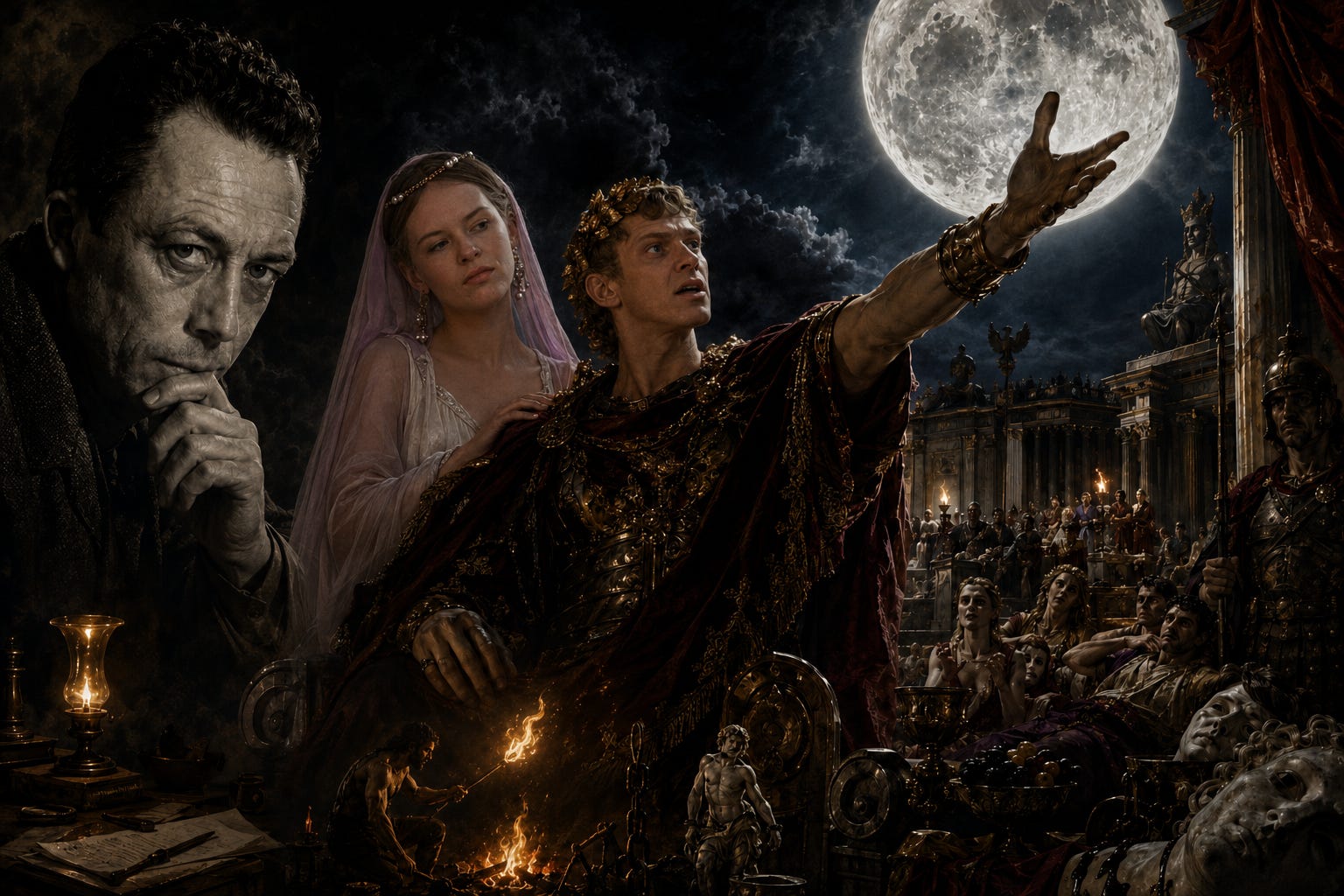
“Really, this world of ours, the scheme of things as they call it, is quite intolerable. That’s why I want the moon, or happiness, or eternal life – something, in fact, that may sound crazy, but which isn’t of this world. …It’s just because no one dares to follow up his ideas to the end that nothing is achieved. All that’s needed, I should say, is to be logical right through, at all costs.”
– Albert Camus, Caligula (Act 1, Scene 4)
Among all the creations of Albert Camus, Caligula is perhaps the one closest to becoming a genuinely mythic figure and yet also the protagonist most persistently misunderstood. It has never been asked, as it should have been asked, why I opened my magnum opus Prometheus and Atlas (written in 2012, published in 2016) with an epigraph from Camus’ play Caligula, especially when Camus is not mentioned even once in the rest of the book (despite his having had some things to say about Prometheus in both The Rebel and The Myth of Sisyphus). The epigraph, from Scene 9 of Act 1, reads: “I’m playing into your hand, and with your own cards... I’m exploiting the impossible. or, more accurately, it’s a question of making the impossible possible... something that would bring about the one real revolution in this world of ours, if people would only take it in.” What I do not include in the quote is Scipio’s reply, “But that game may lead to – to anything! It’s a lunatic’s pastime.” An ironic line to be sure, since Caligula wants the moon. He replies to Scipio: “No, Scipio. An emperor’s vocation… From this day on, so long as life is mine, my freedom has no frontier.” The protagonist of Camus’ 1945 tragic drama is based on Gaius Caligula Caesar Germanicus, the third of the Roman Caesars, who ruled the empire from 37–41 AD. The misunderstanding of Caligula in this play is especially ironic because Camus himself repeatedly attempted to explain what he thought he was doing with the character. In the preface to Caligula, he insists that the mad Caesar is not to be understood as a historical reconstruction of the Roman emperor, nor even primarily as a study of political tyranny. For Camus, Caligula is a philosophical figure. He is a man who has discovered a truth about existence and who attempts to draw all of the consequences from that discovery, regardless of where the path leads.
Camus presents Caligula as a man who learns that “men die and are not happy,” a man who discovers the absurdity of existence and then attempts to remake the world in light of that revelation. Yet for all of Camus’ brilliance, and despite the profound admiration that I have for him, I cannot help but feel that he ultimately shrinks back from the full implications of the figure that he has created. Camus remains, in the end, too much of a moralist, too much of a humanist who is committed to preserving a certain ethical horizon. He sees Caligula as a cautionary tale. I see him as something far more troubling and therefore far more interesting: namely, a failed initiate into mysteries that he only partially comprehends.
Keep reading with a 7-day free trial
Subscribe to Jason Jorjani to keep reading this post and get 7 days of free access to the full post archives.