NOWRUZ
The Meaning of Iranian New Year, from Chaharshanbeh Suri to Sizdeh Bedar.

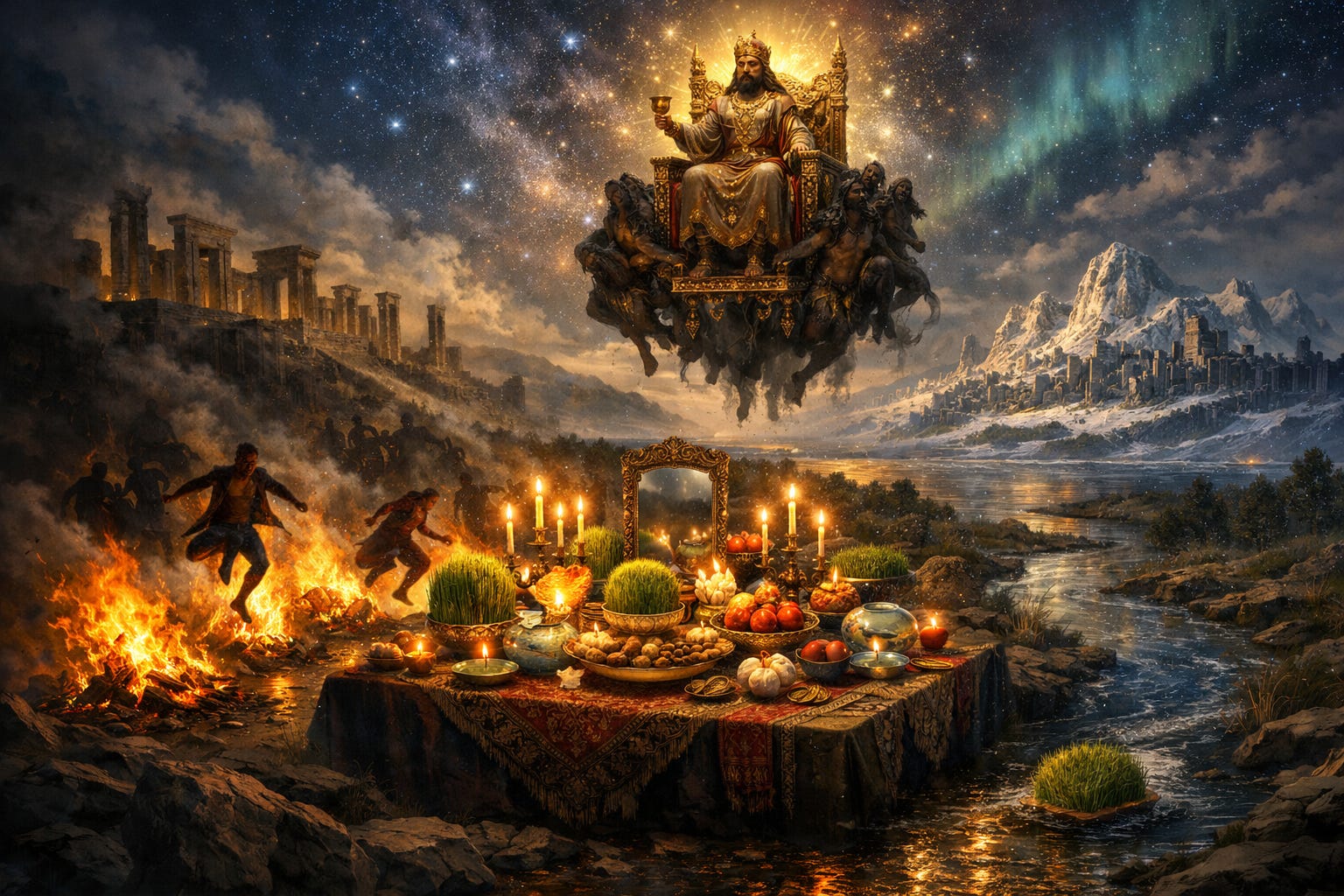
To approach Nowruz merely as a cultural festivity or seasonal celebration is to remain blind to the profound metaphysical architecture that it encodes. The Iranian New Year, celebrated for at least the 2,585 years of the Imperial calendar dating back to Cyrus the Great, is nothing less than the ritual condensation of a primordial cosmology – a cyclical drama of creation, catastrophe, and renewal whose roots reach back into the deepest strata of Indo-Iranian consciousness. From the fire rites of Chaharshanbeh Suri, which preserve the archaic expulsion of demonic forces, to the vestigial echoes of Mehragân that have migrated westward into the masquerades of Halloween, we are confronted with the survival of a prehistoric ritual system that once governed the thresholds between worlds – between order and chaos, the living and the dead, the human and the divine.
At the center of this symbolic constellation stands the figure of Jamshid, not as a benign culture hero, but as the Promethean sovereign whose ascent upon a throne raised by the Daevas marks the apex of human ambition and the prelude to an imposed civilizational collapse supposedly punishing titanic hubris. In his elevation we glimpse the memory of the rise and fall of Atlantis – the cradle of the Aryans. Thus, Nowruz reveals itself as a festival of profound ambivalence: a celebration of rebirth shadowed by the memory of destruction, a reenactment of cosmic order that is inseparable from the chaos it must continually overcome.
What unfolds across the thirteen days of the Nowruz cycle – from the purifying fires to the symbolic microcosm of the Haft Sin and the final dissolution of Sizdeh Bedar – is nothing less than a dramatization of the entire arc of cosmic time. Here, the Iranian vision of existence discloses itself in its full philosophical depth: a universe perpetually oscillating between Asha and its negation, between the luminous order embodied by the Amesha Spentas and the shadowy dominion of the Daevas. Nowruz, then, is not simply the beginning of a year. It is the remembrance of the Iranian conception of the structure of Being itself – of a world that is reborn through the fire of its own destruction.
Chaharshanbeh Suri
To understand Nowruz in its full mytho-historical depth one must recognize that the Iranian New Year was never merely a calendrical convention. It was the ritual axis of a cosmological drama that unfolded across the entire cycle of the Iranian sacred year. The festival that begins with Shabé Chaharshanbeh Suri or “the Eve of Red Wednesday,” and culminates in the vernal equinox, preserves fragments of a far older system of seasonal rites whose origins reach back to the Indo-Iranian Bronze Age. Only by tracing the transformations of these rites – from the archaic Mehragân New Year of the autumn equinox to the spring festival of Nowruz – can we grasp the strange constellation of symbols that surround the Iranian New Year and the unexpected ways in which these symbols migrated westward into the ritual life of Europe.
In the most ancient stratum of the Iranian calendar, the autumn equinox festival of Mehragân appears to have held a status comparable to that later enjoyed by Nowruz. This was the feast of Mithra, the god of covenant, light, and sovereign justice. Mehragân commemorated the overthrow of Zahhak by Fereydun, a mythic event that signified the restoration of cosmic order after a period of demonic tyranny. In this sense the festival functioned as a New Year celebration in which the victory of justice over chaos inaugurated a renewed cycle of time.
Ritual practices associated with Mehragân reveal striking affinities with customs that survive today in Samhain and ultimately Halloween. Among these were the wearing of disguises, the knocking on doors for offerings, the symbolic expulsion of malevolent spirits from houses, and the ritualized inversion of ordinary social roles. Such practices were not mere amusements. They formed part of an archaic Indo-European strategy for confronting the dangerous threshold between seasons, a liminal moment when the boundary between the human world and the domain of spirits was believed to grow dangerously thin.
In the Iranian context these rites were directed against the Daevas or divs, the demonic forces of Ahriman. During the seasonal transition households engaged in elaborate rituals to cleanse their dwellings of these malign presences. Furniture and walls were struck or shaken to drive out invisible entities lurking within the domestic space. Participants sometimes covered themselves in cloth or sheets to emulate ghosts, transforming themselves into ambiguous figures that could traverse the boundary between the human and spirit worlds. Children or masked participants went door to door receiving offerings of sweets – practices whose structural similarity to later European (and by extension American) customs should be obvious.
When Mithraism gradually yielded to the theological ascendancy of Zoroastrianism, the structure of the Iranian ritual calendar was reorganized. The cosmic emphasis shifted toward the spring equinox and the festival of Nowruz, which came to symbolize the rebirth of the world after the winter of cosmic struggle. Yet the older Mehragân rites did not simply disappear. Instead, elements of them were transferred to the threshold festival that precedes Nowruz, the fire festival known as Chaharshanbeh Suri.
This remarkable celebration occurs on the eve of the final Wednesday before the New Year and retains unmistakable features of archaic spirit-expulsion rituals. The central act of leaping over fire while invoking the formula “zardi-ye man az to, sorkhi-ye to az man” expresses a symbolic exchange between the human body and the purifying flame. Illness, weakness, and misfortune are cast into the fire, while vitality and radiance are drawn from it. Fire here functions as the visible manifestation of asha, the cosmic order that burns away the forces of Ahriman.
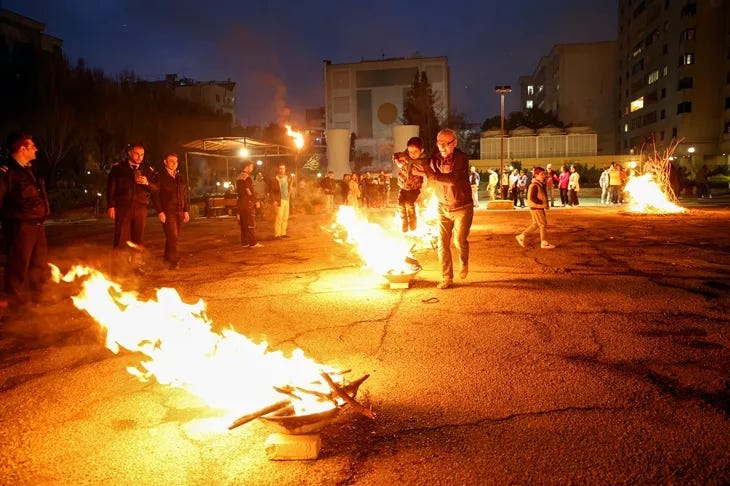
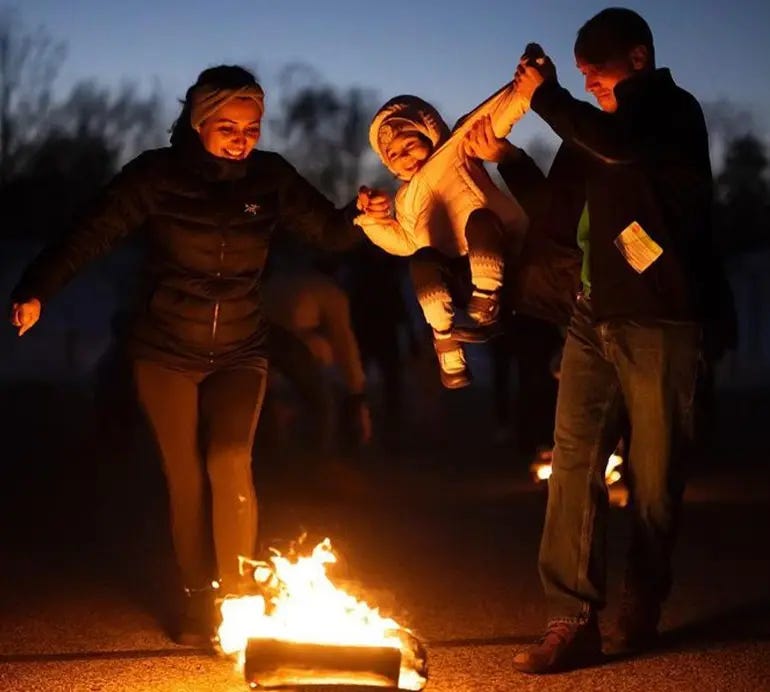
Yet alongside this solemn symbolism survive playful customs that preserve the deeper memory of the older Mehragân rites. Participants may disguise themselves with cloth coverings, echoing the ancient practice of adopting ambiguous identities during liminal festivals. Young people engage in knocking rituals, visiting houses and receiving sweets or offerings. Objects within the household may be struck or shaken as if to drive spirits from the walls and furniture. These curious practices are vestiges of the archaic attempt to purge the domestic sphere of divs before the renewal of the world at Nowruz.
When one situates these Iranian rites within the broader Indo-European cultural sphere, the parallels become extraordinary. The Celtic festival of Samhain, which later evolved into Halloween, shares the same structural features: disguises that blur the boundary between human and spirit, visits to houses in search of offerings, and rituals intended to protect households from wandering entities during a dangerous seasonal threshold. Even the modern image of ghosts disguised in white sheets recalls the ancient practice of adopting shrouded forms that mimic the appearance of spirits themselves.
Such similarities are not accidental. They point to a shared ritual heritage rooted in the prehistoric Indo-European world. As Iranian religious ideas spread westward through the Roman Empire – particularly through the cult of Mithras, which flourished among Roman soldiers – elements of Iranian seasonal rites may have mingled with local European traditions. Over centuries these motifs were transformed, Christianized, and folklorized, eventually emerging in the familiar forms of Halloween.
The fires of Chaharshanbeh Suri burn away the lingering presence of demonic disorder so that the world may enter the New Year purified. Only after the spirits have been expelled and the household cleansed can the symbolic universe of the Haft Sin table be assembled, recreating the ordered cosmos in miniature.
Seen in this broader perspective, Nowruz is not simply the celebration of the Spring Equinox (March 19, 20, or 21). It is the final act of a ritual drama that begins with the confrontation of chaos and ends with the restoration of cosmic harmony. The fires of Chaharshanbeh Suri drive the divs from the world; the equinox restores balance between light and darkness; and the New Year dawns upon a universe that has been symbolically reborn.
Before renewal can occur, the forces of disorder must first be confronted and expelled. The flames that leap in the night before Nowruz illuminate an ancient truth – that civilization itself depends upon the perpetual struggle to maintain order against the encroaching shadows of chaos. In the flicker of those flames one may glimpse the distant ancestors of the lanterns and costumes that still appear each autumn in another part of the Indo-European world, where the memory of that same ancient struggle survives under a different name: Halloween.
The Throne of Jamshid, the Daevas, and the Amesha Spentas
The symbolism of Nowruz becomes considerably more intelligible once it is read not merely as a seasonal festival but as the ritual memory of a Promethean catastrophe at the dawn of civilization. The mythic king Jamshid, who inaugurates Nowruz by ascending into the heavens upon a radiant throne raised by the divs, is not simply a culture hero presiding over the renewal of spring. He is, rather, the Iranian archetype of the rebellious world-sovereign, a figure whose attempt to transcend the limits imposed upon humanity provokes the destruction of his own civilization.
In the Iranian epic tradition, Jamshid commands the divs – the daevas – to raise his throne into the sky. Suspended between earth and heaven, he surveys the world from a vantage point that symbolizes the apotheosis of human power. The imagery is unmistakably that of a technological or magical elevation of humanity above the natural order. The king rises like a god, enthroned in the firmament, and in that moment humanity appears to have achieved mastery over the cosmos. But this triumph is deeply ambiguous. In the revolutionary Zoroastrian reinterpretation of earlier Indo-Iranian mythology, the Daevas still worshipped by Hindus, namely the old Indo-European “gods,” such as the Olympians of the Greeks, are deceptive and sadistic archons of Ahriman opposed to the divine order of Ahura Mazda and Mithra. For Jamshid to command them to empower his ascent represents a Promethean rebellion, a moment when human sovereignty seeks to transcend the limits set by the gods. This moment is commemorated as Now-ruz or “New Day.”
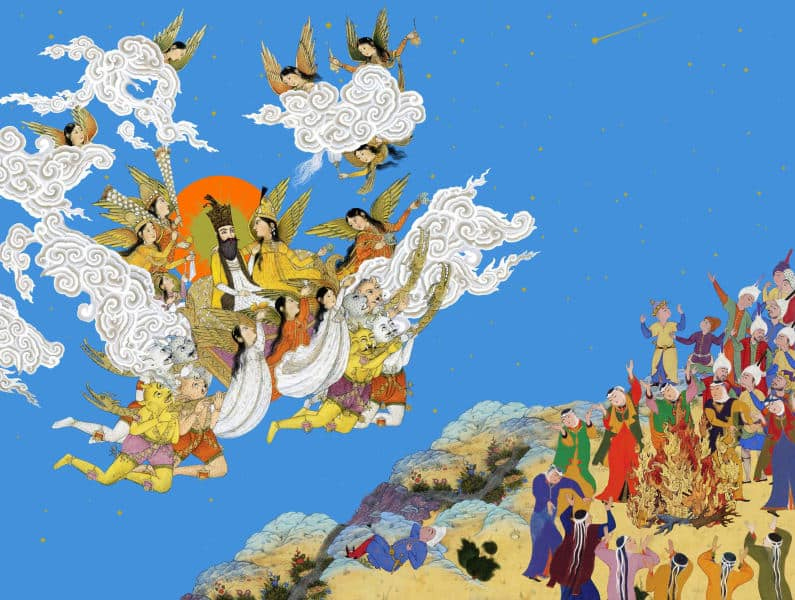
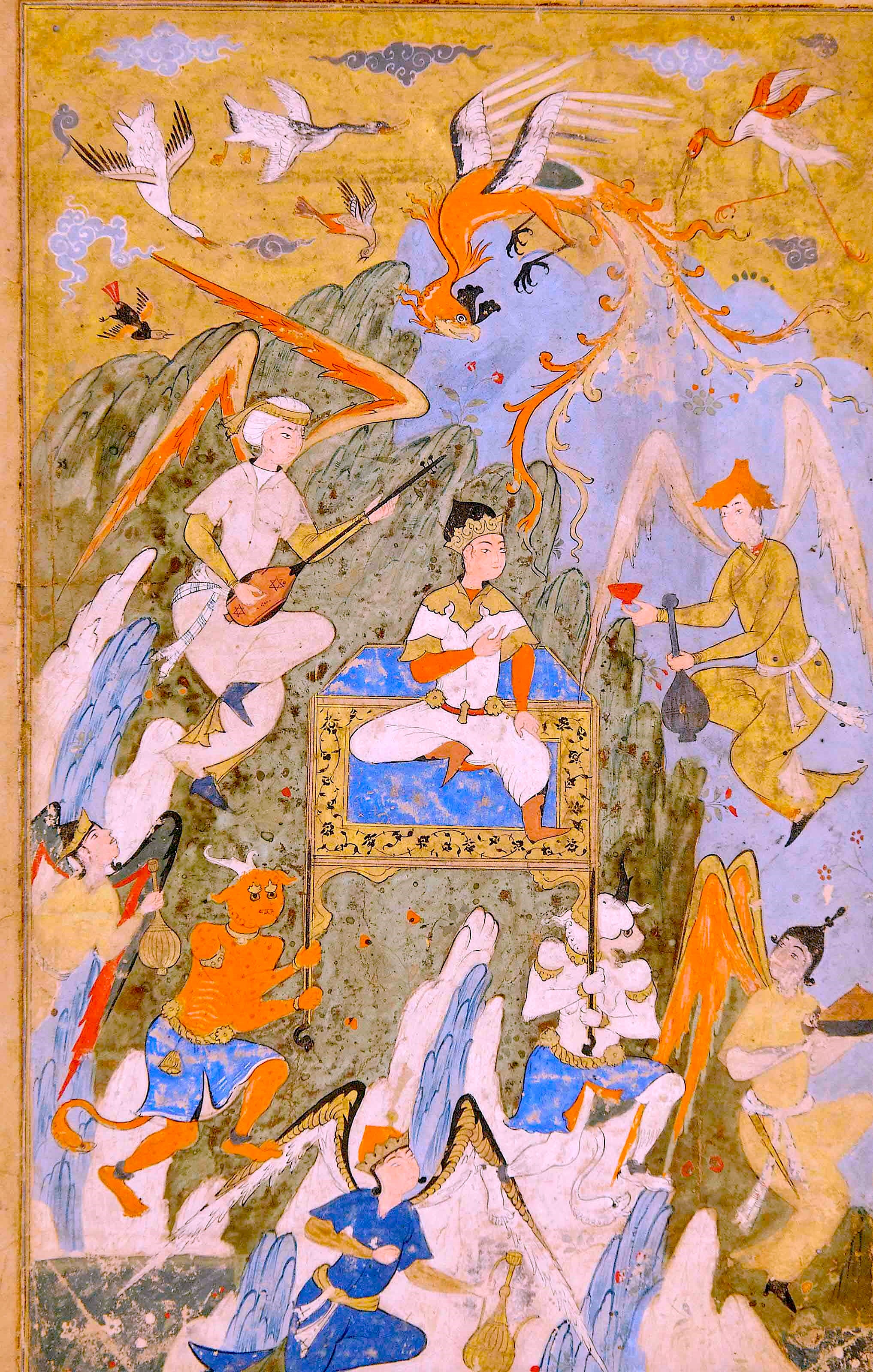
This mythic pattern is strikingly parallel to the Greek story of King Atlas, the primordial sovereign of Atlantis who rebelled against the Olympian order. The Kings of Atlantis were called “the Atlas,” in reference to the titan Atlas, the brother of Prometheus, who led the Titans in a war against Olympus, and who symbolically bears the entire world – the star globe of the heavens – on his own shoulders. Plato (who was considered a member of the Order of the Magi) tells us that Atlantis attempted to extend its sovereignty over the entire world. Jamshid, whose bull-headed scepter also symbolizes the whole Earth, is a King of the World who rules from what the Avesta portrays as a central island-continent. Atlas, like Jamshid, represents an archaic form of world rulership rooted in a civilization that possessed extraordinary powers. The Olympians, led by the Ahrimanic Zeus, defeat Atlas and condemn him to bear the weight of the heavens. The rebellion of the Atlantean sovereign results in the destruction of his civilization beneath the sea.
The Iranian myth preserves a comparable narrative. Jamshid’s elevation is followed by a catastrophic fall. Having claimed divine status for himself, he loses the khvarenah, the royal glory that legitimizes his rule. The cosmic order withdraws its favor, and his world collapses into chaos. The tyrant Zahhak emerges to overthrow him, and the golden age of Jamshid comes to an end. In this sense, the myth of Jamshid encodes the memory of a lost primordial civilization – a world that possessed extraordinary knowledge and power but whose hubris provoked its annihilation. When read alongside the Greek account of Atlantis, the Iranian story suggests a shared Indo-European mythic template: an ancient technological or magical civilization that attempts to challenge the cosmic order and is destroyed as a consequence.
The symbolism of Nowruz takes on a deeper resonance in this context. The festival commemorates Jamshid’s ascent – the moment when humanity reached the height of its power. Yet it also implicitly recalls the catastrophe that followed. The celebration of renewal each spring is therefore shadowed by the memory of a lost world.
This interpretation aligns intriguingly with certain geographical traditions preserved in Iranian cosmology. The Avesta describes Airyanem Vaejeh, the primordial homeland of the Aryans, as a region that became overwhelmed by an unnatural winter sent by the forces of darkness. The land that was once fertile and habitable becomes frozen and desolate. This mythic description resembles a civilization overwhelmed by polar ice. It is most intriguing that, according to the Avesta, King Jamshid (known as Yima in Avestan) knows that the catastrophic freezing over is coming, and so he builds a vast underground city – a var – for at least some of the Aryans to survive the calamity. If one considers the possibility that Atlantis lay in what is now Antarctica – as argued by Charles Hapgood, Rand Flem-Ath, and Colin Wilson – the parallels become even more provocative. A once-temperate region transformed into an icy wasteland, a technologically advanced civilization destroyed by cosmic upheaval, and the survival of its memory in the mythic traditions of multiple Indo-European cultures – these motifs converge in a pattern that invites comparison.
Within such a framework, the ascent of Jamshid upon a throne raised by the divs might symbolize the technological prowess of this primordial civilization. The rebellion against the cosmic order would represent the moment when its rulers attempted to transcend the constraints of the natural world. The subsequent collapse of Jamshid’s reign would encode the catastrophe that destroyed that civilization and forced the survivors, namely the Aryans, to disperse across Eurasia.
Seen in this light, Nowruz becomes far more than a New Year celebration. It is the ritual remembrance of humanity’s lost golden age – and of the catastrophic hubris that brought it to an end. Each spring the festival reenacts the moment of Jamshid’s ascent, the height of human power and brilliance. But it also implicitly warns of the fall that follows when human ambition attempts to rival the gods.
This ambivalent symbolism gives Nowruz its enduring philosophical depth. The festival celebrates renewal, but it also preserves the memory of a forgotten catastrophe. It reminds humanity that civilization itself is cyclical – that golden ages rise and fall, and that the forces that elevate humanity can just as easily destroy it. In that sense, Nowruz is both a celebration of rebirth and a cautionary remembrance. It marks the beginning of a new year, but it also echoes with the distant memory of a world that once reached toward the heavens and was cast down for its audacity.
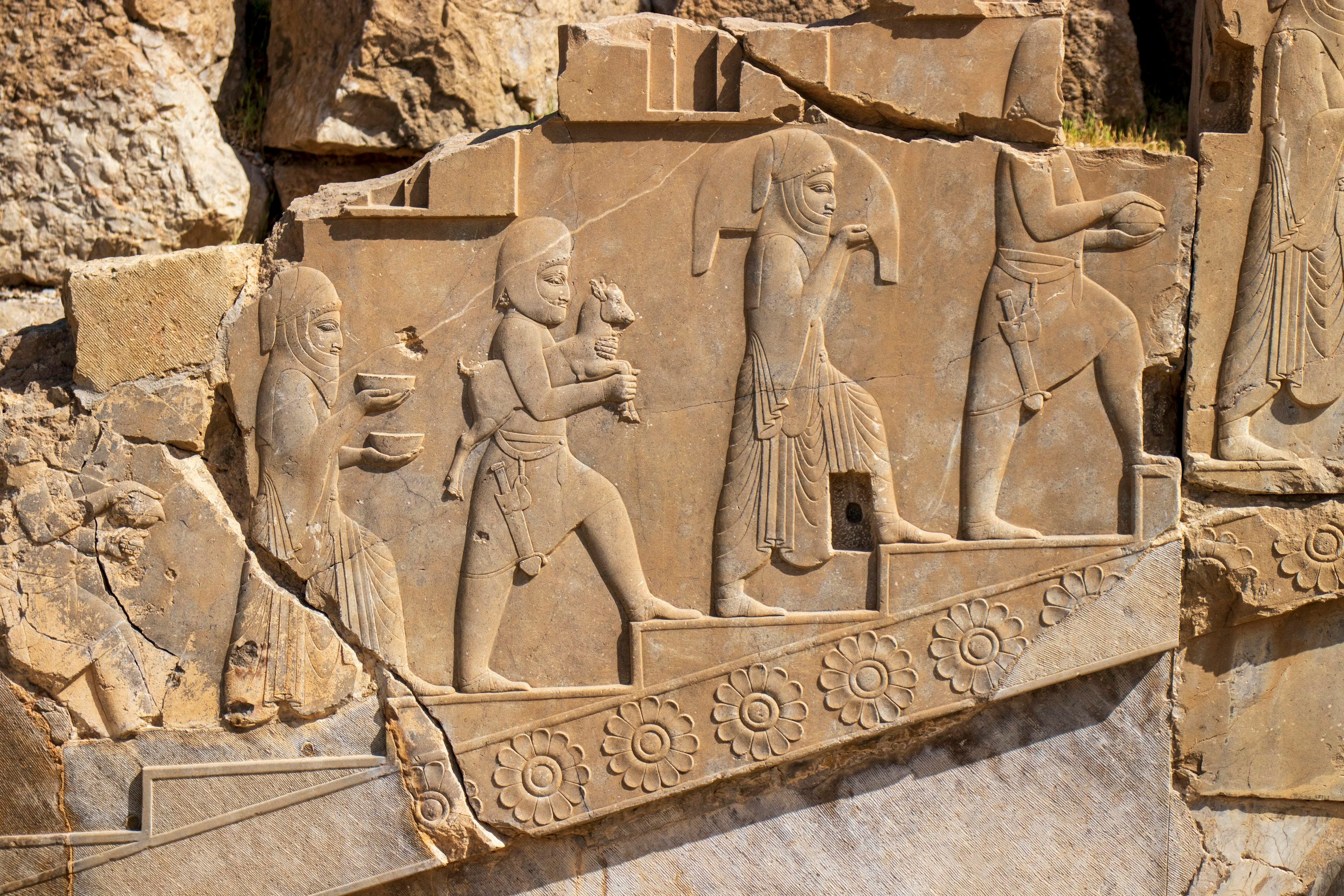
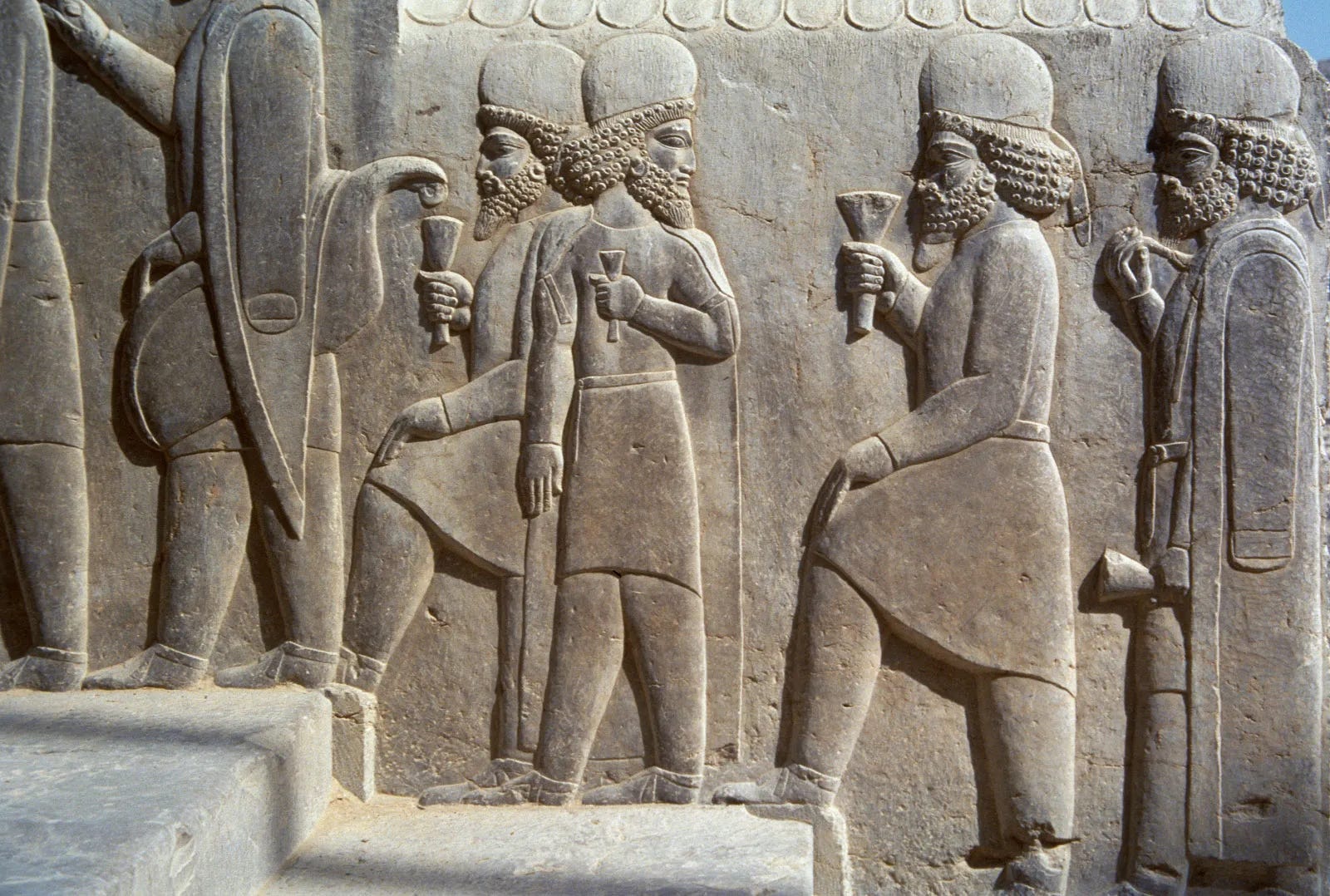
This symbolic relationship between kingship and cosmic order found monumental architectural expression in Persepolis, the ceremonial heart of the Achaemenid Empire, which is also symbolically referreed to as Takht-e-Jamshid or “the Throne of Jamshid,” namely the one raised to the heavens by the Daevas bound by the Iranian King of the World. The great terraces of Takht-e Jamshid were not merely the setting for imperial audiences; they were the stage upon which the cosmic drama of Nowruz was reenacted each year. Delegations from across the empire ascended the grand Apadana stairways bearing gifts, converging upon the throne of the Great King as if participating in a ritual ascent toward the axis of the world. The empire gathered beneath the king not only as a political entity but as a reflection of the ordered cosmos itself.
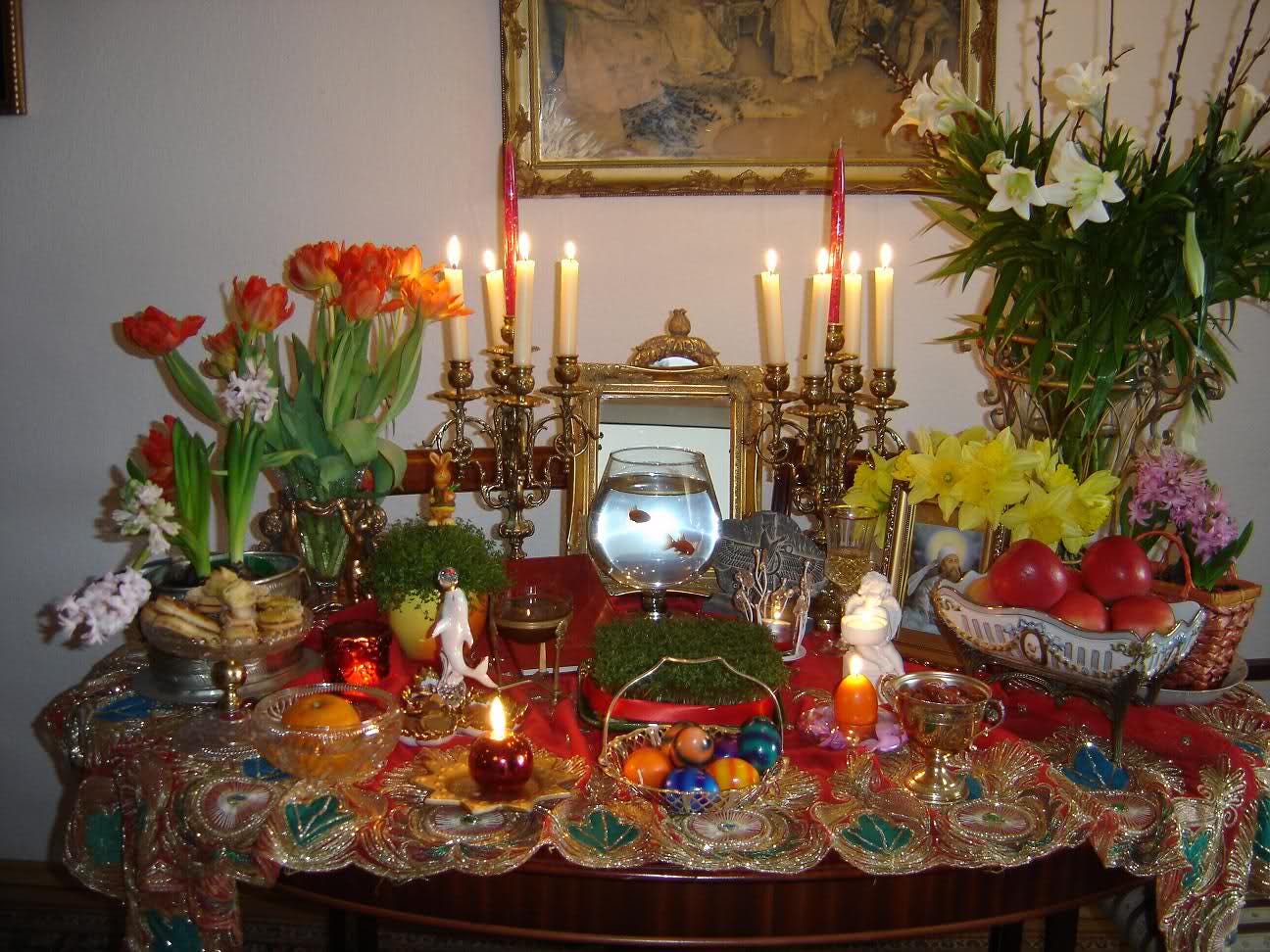
The symbolism of Nowruz, however, does not remain confined to imperial spectacle. It is reproduced on the intimate scale of the household through the arrangement of the Haft Sin or “seven s” spread, the table or altar of seven symbolic objects each standing for one of the Amesha Spentas or “bounteous immortals” that are facets or functions of Ahura Mazda, the super-intelligence of titanic wisdom that fosters and sustains the evolving cosmos. Each item on the New Year altar thus becomes a tangible symbol of a principle through which life, order, and progress are maintained.
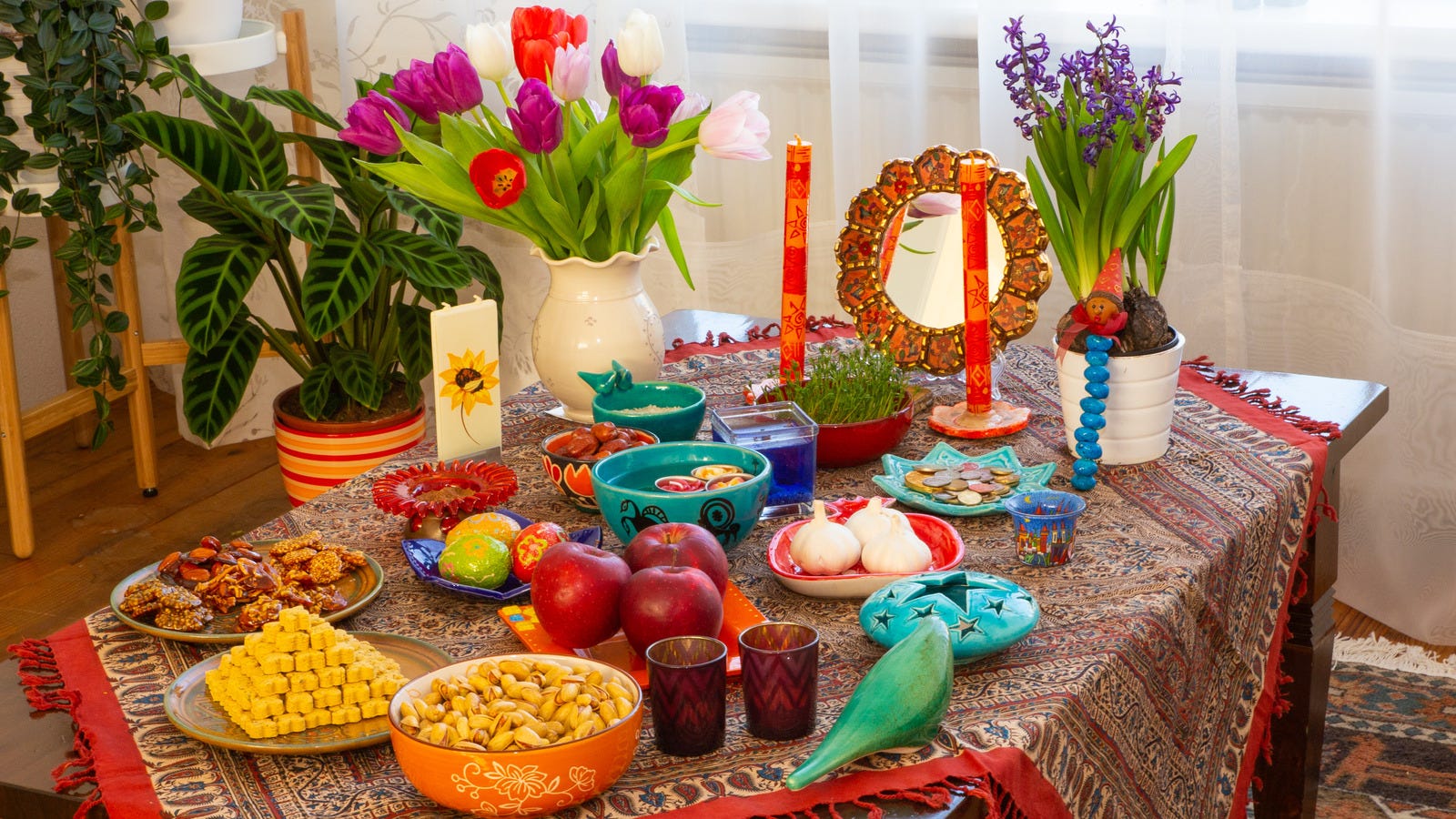
The specific symbolism has shifted repeatedly throughout the centuries, but one interpretation of the correlation could be the following: eggs for the creative or progressive mentality (Spenta Mainyu, Sepand Minou); fire or a candle flame for cosmic order (Arta Vahishta, Ordibehesht); a mirror for the pure or best mind (Vohu Manah, Bahman) as well as a living creature (usually a goldfish) symbolizing humanity’s duty of stewardship over other forms of life lacking the same discerning intelligence; metal coins, especially bearing a monarch’s portrait, for right sovereignty (Khashatra Vairya, Shahrivar); water and garlic for wholeness and health (Haurvatat, Khordad); senjed, samanu, and vinegar for patience or serenity (Spenta Armaiti, Sepandarmad); grass or vegetation and an apple for vitality or immortality (Ameratat, Amordad). These are the powers through which Jamshid was able, by embodying them, to overpower and bind the Daevas, forcing them to help him storm heaven upon a throne that becomes a celestial conveyance.
Sizdeh Bedar
The temporal dimension of Nowruz reveals an even deeper metaphysical significance. According to the ancient Iranian conception of sacred time, the history of the world unfolds over a twelve-thousand-year cycle. The first 3,000 thousand years belong to Ahura Mazda and the uncreated archetypes of all things (farvahars). The second 3,000 years is a period of the admixture of light and darkness and the battle against Ahriman in the physical world. The third and final epoch of 3,000 years represents the era of the increasing victory of the light of Mazda and the eventual destruction of Ahriman, the Daevas, and their human minions in a global conflagration that renews the world in a perfect instantiation of archetypes. This is known as the Frashokereti or Frashgard. This cosmic cycle was symbolically represented by the twelve days of the Nowruz festival. Each day corresponds to one of the millennial epochs through which the drama of creation progresses toward its final resolution. The festival therefore compresses the entire history of the cosmos into a ritual sequence of thirteen days.
This cosmological symbolism becomes particularly striking in the significance of the thirteenth day, celebrated as Sizdeh Bedar or “thirteenth to the door.” While the first twelve days of Nowruz represent the ordered structure of cosmic time, the thirteenth day gestures toward the dissolution that lies beyond the limits of the created world. It is the return of the cosmos or Sepehr or Zurvan, the androgynous deity or Aeon of cosmic time from out of which Ahura Mazda (Ohrmazd) and Ahriman are born as primordial “twins.”
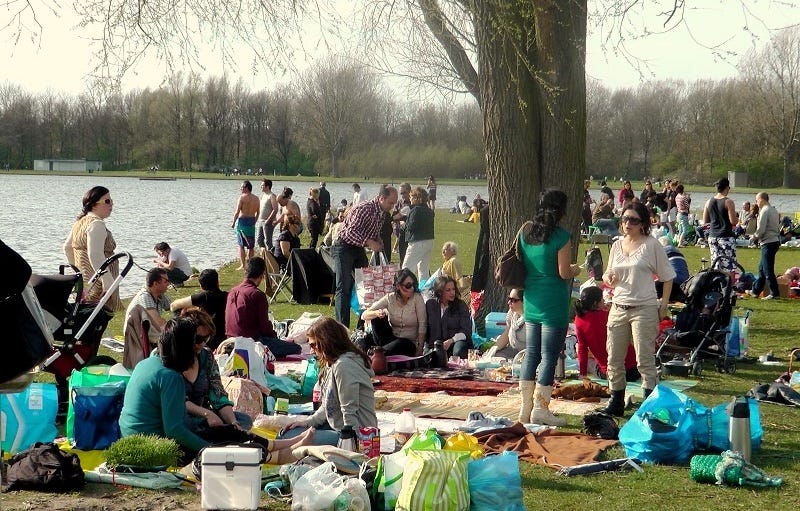
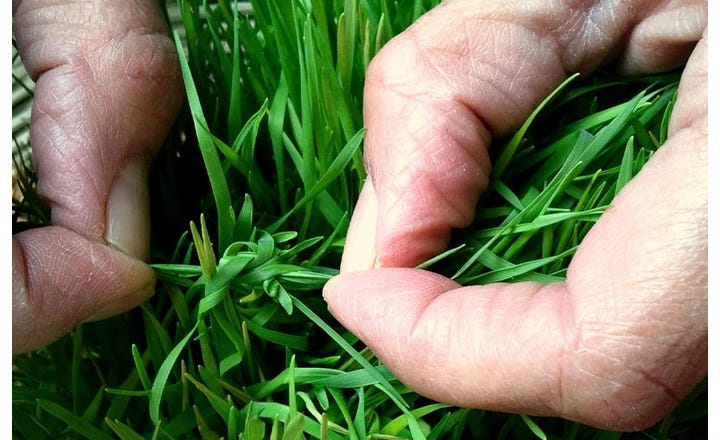
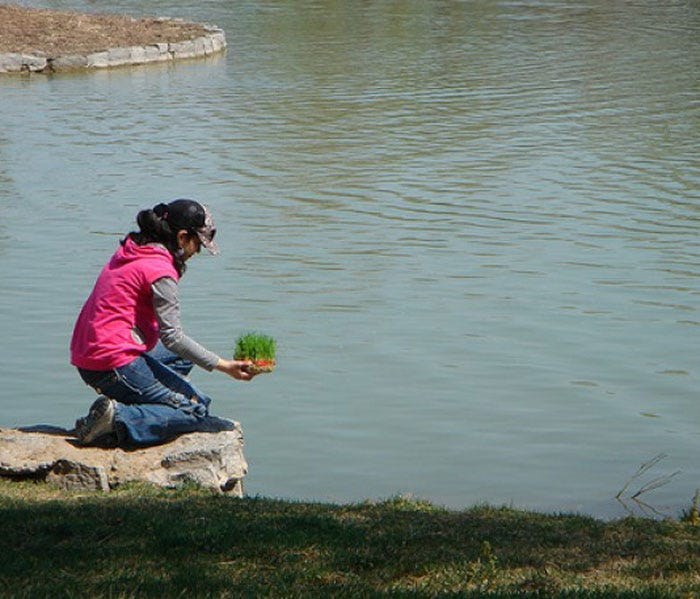
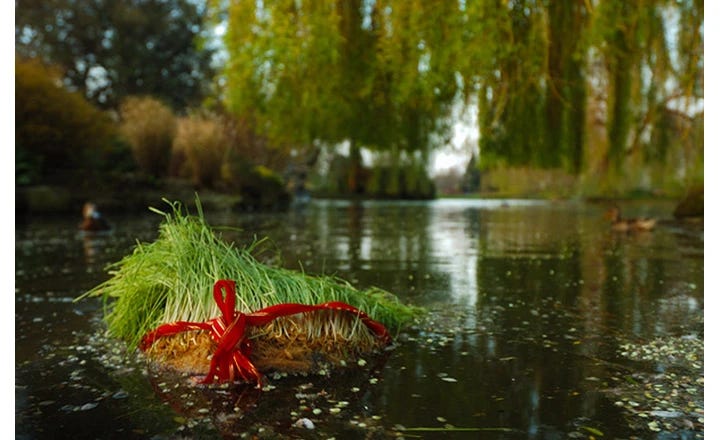
Iranians spend this day outdoors in nature to avoid ill fortune. They release the grass or Sabzeh from their Haft Sin into water, in a creek, river, or lake, after having tied blades of grass in it while making a wish for the New Year. On the surface this appears to be a simple folk practice. Yet its symbolic meaning is profound: the thirteenth day marks the moment when the cosmos dissolves back into primordial chaos before the cycle begins anew. Thus the festival of Nowruz embodies a complete metaphysical vision of time. Creation emerges from chaos, unfolds through ordered epochs, and ultimately collapses once more into the abyss from which it arose.
When viewed in this light, Nowruz stands alongside Mehragân, the autumn festival commemorating the overthrow of the tyrant Zahhak by the hero Fereydun. Together these two celebrations articulate the rhythm of Iranian mythic time. Mehragân marks the victory of justice over tyranny, while Nowruz inaugurates the rebirth of the world after order has been restored. One festival commemorates liberation; the other inaugurates renewal.
This profound cosmological symbolism explains why Nowruz has endured through the rise and fall of empires, the transformations of religion, and the upheavals of history. It is not merely a cultural custom but the ritual expression of a worldview rooted in the deepest layers of Iranian Civilization. The historical memory of lands that were once part of this civilization, and in some cases are waiting to rejoin its heart, can be seen in the celebration of the Iranian New Year from Turkey to Tajikistan and Azerbaijan to parts of Pakistan and India. Each spring, when the sun crosses the celestial threshold and the earth awakens from winter, the ancient Iranian vision of the cosmos reasserts itself. Nowruz is therefore the celebration of more than a new year. It is the remembrance of humanity’s place within the vast architecture of time that upholds a cosmic battle in which light is destined to triumph over darkness.
I don't have a goldfish, will my hamster work? ...kidding Jason! This article is a jewel in your obelisk. Happy Nowruz! 🔥💚
Really enjoyed this article. Thanks! Nowruz Pirooz! Would love to connect and share about my work on ancient Haoma.