THE SHINING APOLLO

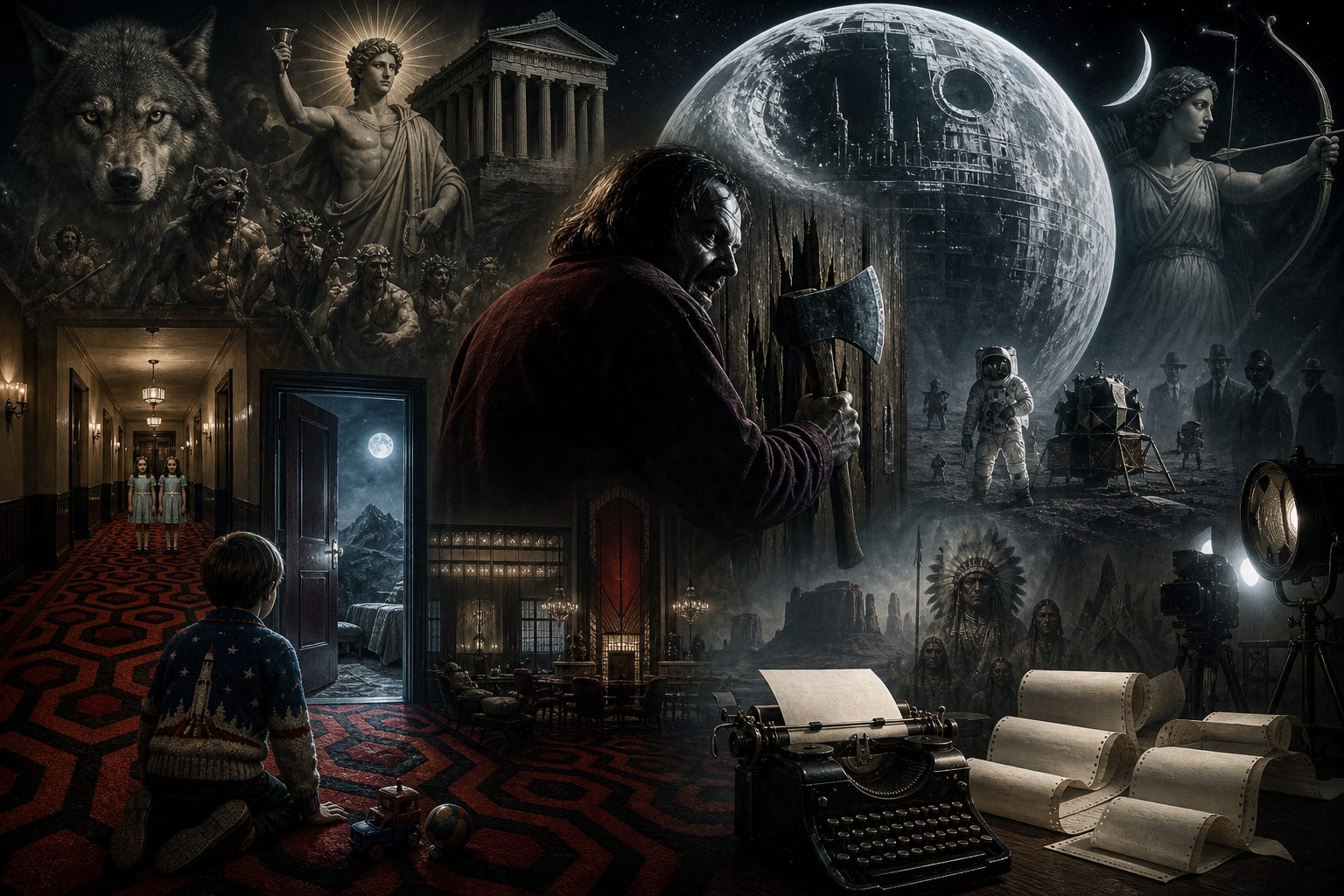
Apollo was not always the serene god of clarity, measure, and solar reason. Beneath the polished marble of the Apollonian stands a wolf-man howling at the Moon. Following Carl Ruck, I argue that Apollo’s earliest identity was lycanthropic, initiatory, intoxicating, and predatory, and that what Nietzsche later calls the Dionysian was once embedded within Apollo himself. Dionysus is not simply Apollo’s opposite; he is the displaced custodian of Apollo’s abandoned darkness. Artemis, in turn, preserves another remainder of this archaic Apollo: the wilderness, the nocturnal threshold, the lunar ambiguity that illuminates without mastering. Together, Apollo and Artemis reveal that light itself is bifurcated into solar disclosure and lunar occultation.
From this mythic foundation, I turn to Stanley Kubrick’s The Shining as a cinematic labyrinth in which Apollo, the Moon, and genocidal trauma converge. Danny’s Apollo 11 sweater, Room 237 as the “Moon Room,” Jack’s contractual servitude to the Overlook, and the mechanized repetition of “All work and no play” become fragments of a cryptic confession from Kubrick about his secret studio production of the Apollo 11 lunar mission footage shown to the American public and the world at large. Jack’s lupine assault on the bathroom door, his “huff and puff,” is not merely fairy-tale madness. It is the return of Apollo Lykeios, the wolf-god, shining destructively through a man who has become the instrument of a haunted structure.
The Overlook is haunted not only by personal madness, but by the genocidal foundations of modern American power. The hotel’s impossible architecture encodes repression; its Native American motifs mark the buried crime on which America was built; the Adler typewriter, numerical references to 1942, and bureaucratic repetitions open onto the machinery of the Holocaust and how its architects were integrated into the post-World War II military-industrial and intelligence complex of the United States. The horror hidden in Room 237 is the horror of the Moon itself. The Apollo program, shaped by Paperclip Nazis and occulted by intelligence secrecy, becomes inseparable from the suspicion that the Moon is not merely a natural satellite but an artifact, a stabilized threshold, perhaps even a camouflaged space station.
Whether approached through anomalous lunar science, suppressed astronaut testimony, or the alleged medical-channel communications of Apollo 11, the Moon emerges as the ultimate Overlook: luminous, silent, artificially constructed, and filled with a secret that official reason cannot assimilate. The Shining is not simply about madness, cinematic production, Apollo, genocide, or the Moon. It is about how illumination itself may become a means of illusionary concealment. In short, it is about the duality of Apollo – or as Kubrick puts it in Full Metal Jacket, “the duality of Man.”
Lycanthropic Apollo and Dionysian Ecstasy
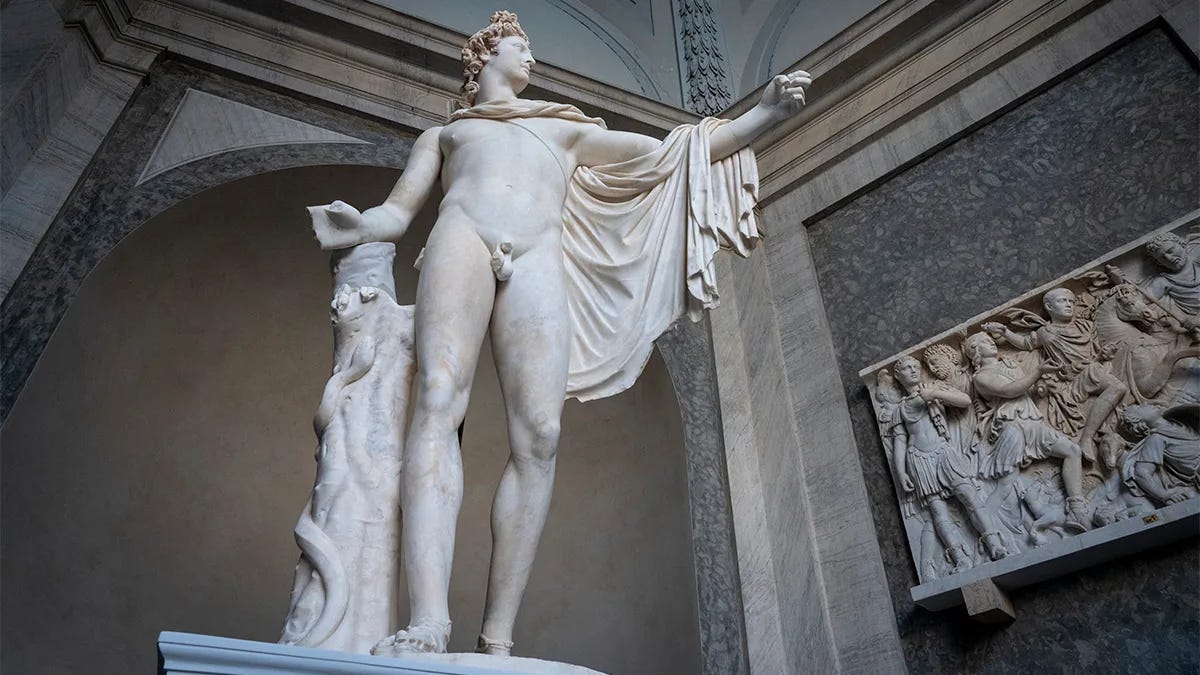
One of the most consequential errors in the interpretation of Greek religion – and, by extension, in the philosophical self-understanding of the West – lies in taking Apollo at face value. The radiant god of measure, harmony, and lucid form is not a static figure of origin but an alchemical process of manifestation. The figure that stands bathed in light on the heights of Olympus is the end product of a long and violent process of theological refinement. If we are to think seriously about the genesis of the Apollonian, we must follow Carl A. P. Ruck into a darker terrain, one in which Apollo is not yet purified, not yet solar, but lupine – entangled with intoxication, initiation, and sacrificial violence.
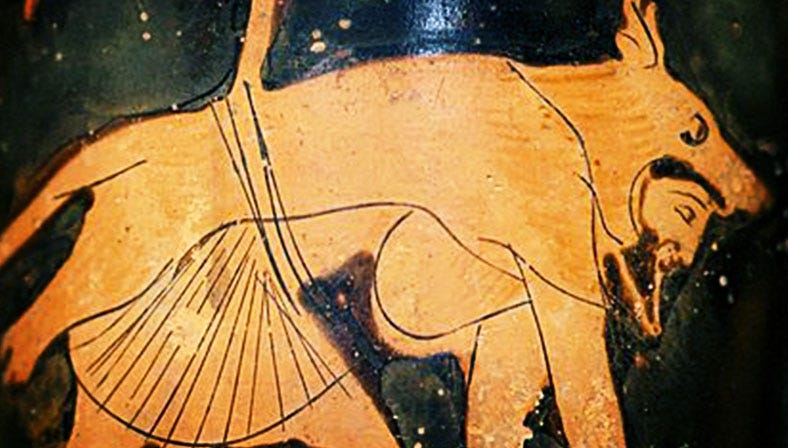
Ruck’s reconstruction in his revolutionary article “The Wolves of War” forces us to confront a fact that philosophical abstraction has obscured: Apollo was once a wolf-god. Not metaphorically, but ritually, ontologically, and experientially. He presided over warrior fraternities who imagined and, under the influence of entheogenic sacraments, experienced themselves as wolf packs. These were initiatory orders in which the young man crossed a threshold, shedding his civic identity in order to become a predatory being embedded in a collective intelligence. Lycanthropy, in this context, is not superstition but technology – a culturally structured transformation of consciousness.
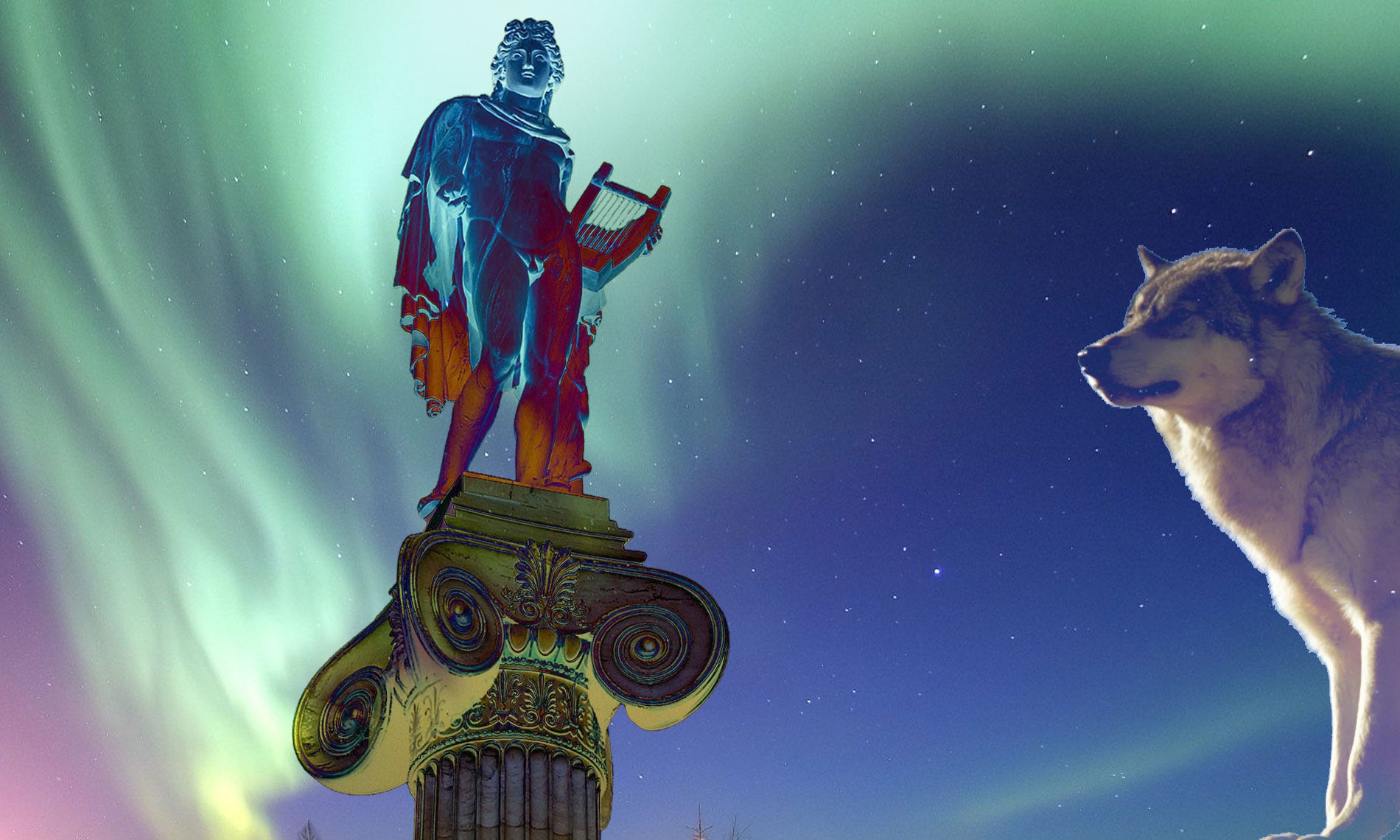
This is where the problem with Friedrich Nietzsche begins to reveal itself. Nietzsche’s Birth of Tragedy offers one of the most profound phenomenologies of Greek culture ever written. He isolates the Apollonian as the principle of form, individuation, and luminous appearance, and opposes it to the Dionysian, the force of intoxication, dissolution, and ecstatic unity. But what Ruck demonstrates is that this polarity is historically inverted. What Nietzsche identifies as “Dionysian” experience – this breakdown of individuation into a collective, intoxicated unity – was once, in its archaic form, under the dominion of Apollo himself.
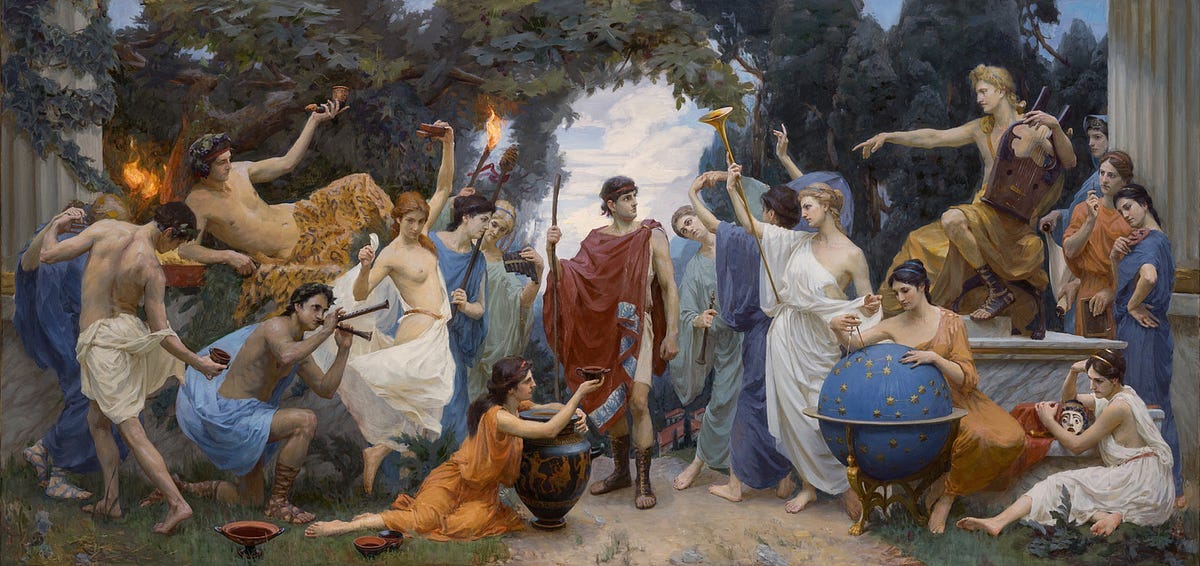
In other words, Nietzsche is describing a structure whose genealogy he does not fully grasp. He gives us the inner experience of these forces, but not their historical stratification. Apollo, in Ruck’s account, is not originally the god of individuation at all. He is the god of its suspension. The wolf-pack initiation is precisely the abolition of the principium individuationis, the dissolution of the individual into a predatory collective. The initiate becomes other-than-human, and it is Apollo who governs this passage.
This transformation is not achieved through symbolism alone. It is catalyzed by substances – what Ruck identifies as an Indo-European sacramental complex involving mushrooms, cannabis, and other psychoactive agents. The wolf is the form taken by consciousness under the influence of these compounds. Here we see the convergence of ritual, neurochemistry, and ontology. What Nietzsche intuits as “intoxication” remains, in his account, a vague aesthetic category. Ruck radicalizes this by grounding it in material practice. The Dionysian is not merely music or rhythm; it is a pharmacological event.
The decisive shift occurs when this entire complex is displaced. As Greek religion evolves, the domain of intoxication, madness, and ecstatic communion is transferred to Dionysus. This is not a simple opposition between two gods; it is a redistribution of functions. Apollo relinquishes the wolf. He relinquishes the mushroom, the mountain revel, the sacrificial frenzy. These are taken up by Dionysus, who becomes the bearer of what Apollo can no longer contain. Only then can Apollo become the god of light.
Apollo does not begin as light; he becomes light by shedding darkness. His luminosity is not primordial but purified, and purification, in this archaic context, is never benign. It operates through the logic of the pharmakon – the drug, the poison, the scapegoat. The beloved youths associated with Apollo – Hyacinthus, Daphnis, Cyparissus – are not incidental figures. They are sacrificial residues, embodiments of the god’s former identity, destroyed or transformed so that the god himself may be cleansed. Apollo’s arrows bring plague. His rites purge the community. His function as “redeemer” is inseparable from destruction. The wolf has not disappeared; it has been sublimated through rites of purification. The god of harmony is still, at a deeper level, the predator who culls the herd.
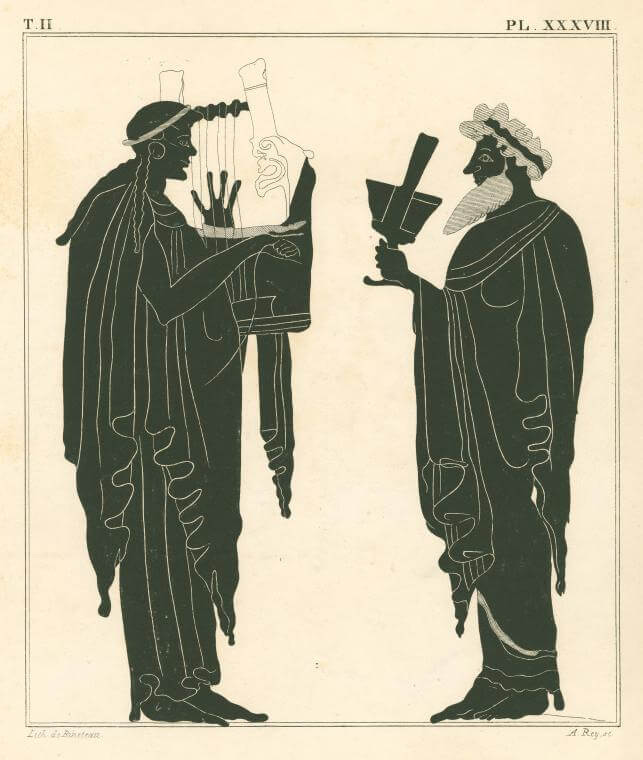
This sheds new light on Nietzsche’s famous polarity. The Apollonian and Dionysian are not simply eternal metaphysical opposites. They are the visible expression of a deeper historical rupture. What Nietzsche treats as a structural tension between form and ecstasy is, from Ruck’s perspective, the result of a split within the divine itself. The Dionysian is what Apollo used to be responsible for. The Apollonian is what remains after that responsibility has been transferred, and yet, Nietzsche is not thereby refuted. He is, in a sense, vindicated at a higher level. For even if the polarity is historically produced, it nonetheless becomes structurally real. Greek tragedy, as Nietzsche understood, is born from the fusion of Apollonian form and Dionysian ecstasy. Ruck’s account allows us to see this fusion as a mediated reconciliation of a prior unity – a unity that had to be broken in order for culture, as we know it, to emerge.
What emerges from this synthesis is a far more unsettling image of Apollo. He is not simply the god of clarity. He is the god who has mastered madness by externalizing it. He stands in the light because he has cast his shadow into Dionysus, into Hermes, into caves, mountains, and sacrificial victims. The wolf survives, but it has been displaced into the wild margins of the sacred.
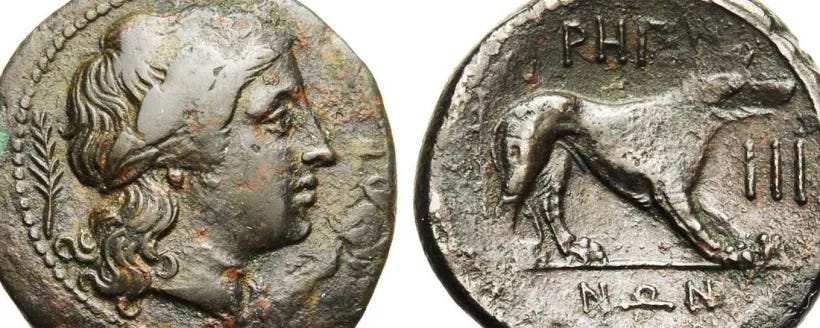
This displacement is never complete. The ambiguity remains encoded in the very name of Apollo – in the tension between lykos (wolf) and lyke (light). What later theology presents as a clean identity is, in fact, a linguistic fossil of an unresolved contradiction. The god of light is still haunted by the wolf he once was. To think Apollo properly, then, is to think the process by which chaos is not eliminated but redistributed. Civilization does not abolish the archaic; it reorganizes it. The ecstatic, the intoxicated, the predatory – these are not eradicated but assigned new domains. Dionysus becomes their custodian. Apollo becomes their sublimator, and what we call “reason,” “form,” and “clarity” are the products of this alchemical operation. They are not the absence of darkness, but a shining illusion that shelters the souls that contemplate its transfixing beauty.
Apollo and Artemis: Return to the Moon
The most profound symbols are not those that present themselves as isolated figures, but those that appear in pairs – tensions held in equilibrium, oppositions that are not contradictions but complementarities. Among the Greeks, no such pairing is more revealing than that of Apollo and Artemis. What we are dealing with here is not merely a mythological brother and sister, but a bifurcation of light itself – two distinct modes of illumination that together define the limits of human cognition and the structure of our encounter with reality.
Apollo is, in his later and more philosophically refined form, the god of clarity. He is the light that reveals, the principle of measure, proportion, and intelligibility. Under his gaze, things stand forth as what they are. The world becomes articulated, ordered, and knowable. This is the light of science, of geometry, of the very possibility of truth as correspondence between mind and world. But this is only half the story of light. For there is another illumination, one that does not dispel darkness but moves within it, one that does not define but suggests. This is the domain of Artemis.
She was not originally a lunar goddess. Artemis begins as something far more archaic: a mistress of animals, a huntress of the wild, a guardian of thresholds. She presides over the liminal zones where the human meets the non-human, where the ordered space of the polis dissolves into the indeterminate expanse of forest and mountain. This is the wilderness of the wolf packs of the primordial and lycanthropic Apollo, who howl at the Moon. Artemis was already a goddess of the night, but not yet of the Moon. That identification comes later, through a process of theological synthesis in which Artemis absorbs the functions of Selene, the personified Moon, and becomes part of a tripartite lunar structure alongside Hecate.
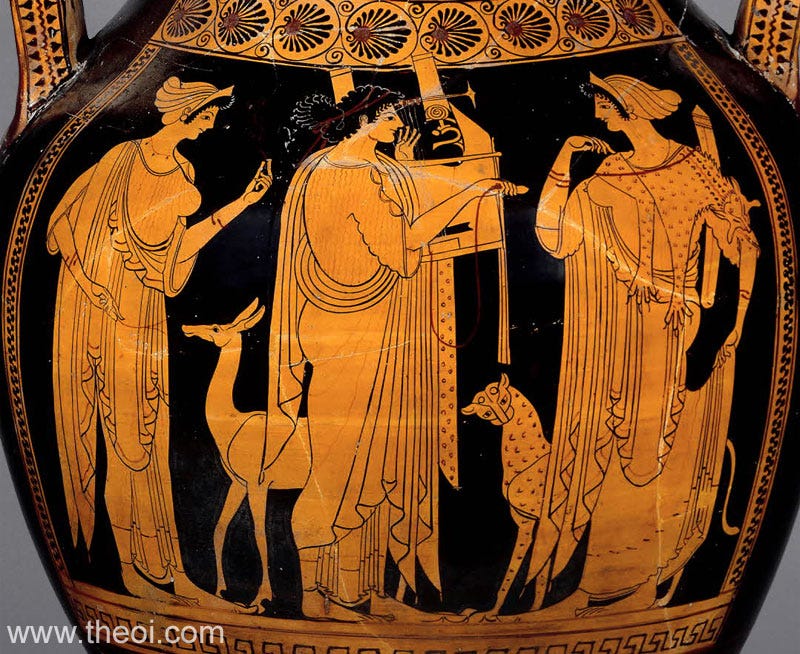
This transformation is not accidental. It reflects a deepening of symbolic thought, a recognition that the Moon is not simply a celestial body but a mode of presence. Unlike the Sun, which dominates the sky with its overwhelming radiance, the Moon offers a light that is partial, shifting, and ambiguous. It illuminates without revealing fully. It creates a world of shadows, of uncertain outlines, of movement glimpsed rather than fixed. Artemis, as lunar goddess, becomes the embodiment of this kind of illumination – the light that guides without defining, that reveals without mastering.
It is precisely here that her twinship with Apollo takes on its full significance. The Greeks understood, at least at an intuitive level, that illumination is not a singular phenomenon. There is a solar light and a lunar light, and these correspond to two different modes of being in the world. Apollo’s light is the light of presence, of what stands before us in clarity and distinction. Artemis’s light is the light of absence, of what withdraws even as it appears, of what moves in the periphery of perception. To put this more sharply: Apollo shows what is. Artemis reveals what is becoming.
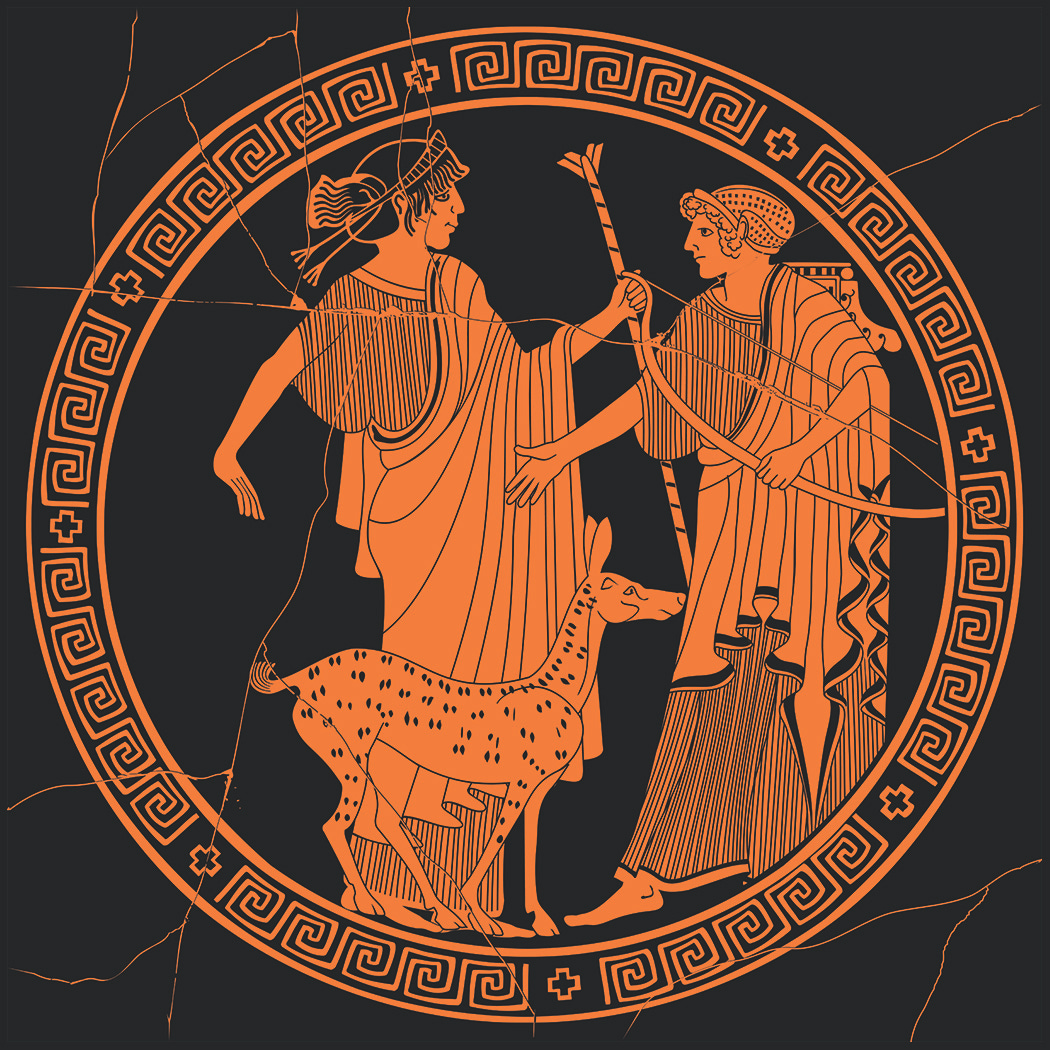
This distinction is not merely poetic. It is ontological. Apollo’s domain is the world of stable identities, of forms that can be grasped, measured, and reproduced. Artemis’s domain is the world of flux, of cycles, of rhythms that resist fixation. Her association with the Moon’s waxing and waning, with the cycles of fertility and the thresholds of life, reflects a deeper connection to processes rather than states. She governs not what something is, but how it changes, and yet, this is not a simple opposition. It is a complementarity. The world cannot be known through Apollo alone, for pure clarity without ambiguity becomes sterile abstraction. Nor can it be navigated through Artemis alone, for pure flux without form dissolves into chaos. It is only through their conjunction that a complete mode of understanding becomes possible. The Greeks encoded this insight in the very fact of their twin birth: Apollo and Artemis emerge together in the classical age of the Greeks, as two aspects of a single cosmic order.
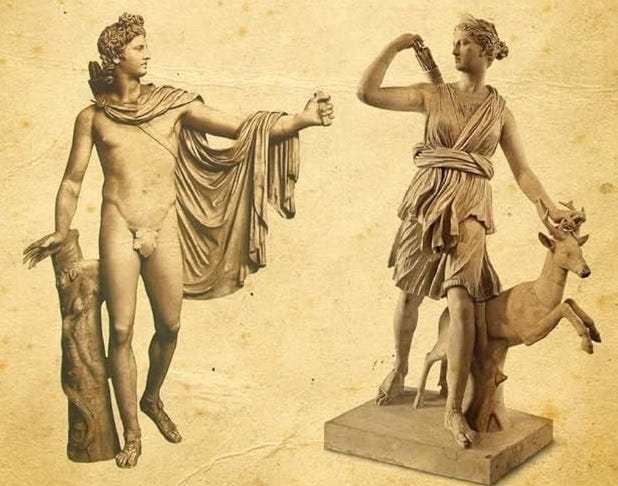
If we consider this pairing in light of the deeper transformations of Greek religion, an even more intriguing pattern emerges. As Apollo becomes increasingly associated with light, reason, and order, he sheds certain archaic aspects – those tied to wildness, danger, and the ambiguous power of the night. These do not disappear. They are redistributed, and it is Artemis, who preserves them together with Dionysus. Therefore, it is no coincidence that the Greek myths tell us that Dionysus was the best friend of Artemis. They are bound together by their relation to Apollo.
In this sense, Artemis is not merely the complement of Apollo. She is also his remainder. She holds what he has relinquished in order to become the god of clarity. She retains the connection to the wilderness, to the unpredictable, to the sudden strike of the arrow that comes without warning. Her arrows, like his, operate at a distance, but their meaning is different. Apollo’s arrow is precision, the targeted application of force. The arrow of Artemis is intrusion, the eruption of the wild into the ordered.
This is why Artemis remains a profoundly ambivalent figure. She is both protector and destroyer, guardian of the young and bringer of sudden death. The Moon itself shares this ambivalence. It is a gentle light, but also an eerie one. It reveals, but in doing so it distorts. It creates a world that is recognizable and yet strange, familiar and yet uncanny. To move under the Moon is to inhabit a space where certainty is suspended.
If Apollo is the god of the known, Artemis is the goddess of the unknown that is nonetheless encountered. She is the guide through that which cannot be fully illuminated. Her virginity, so often misunderstood, is not principally a moral attribute but a metaphysical one. She is unpossessed, autonomous, not subordinated to any external order. Like the Moon, she follows her own cycle, independent of human schemes.
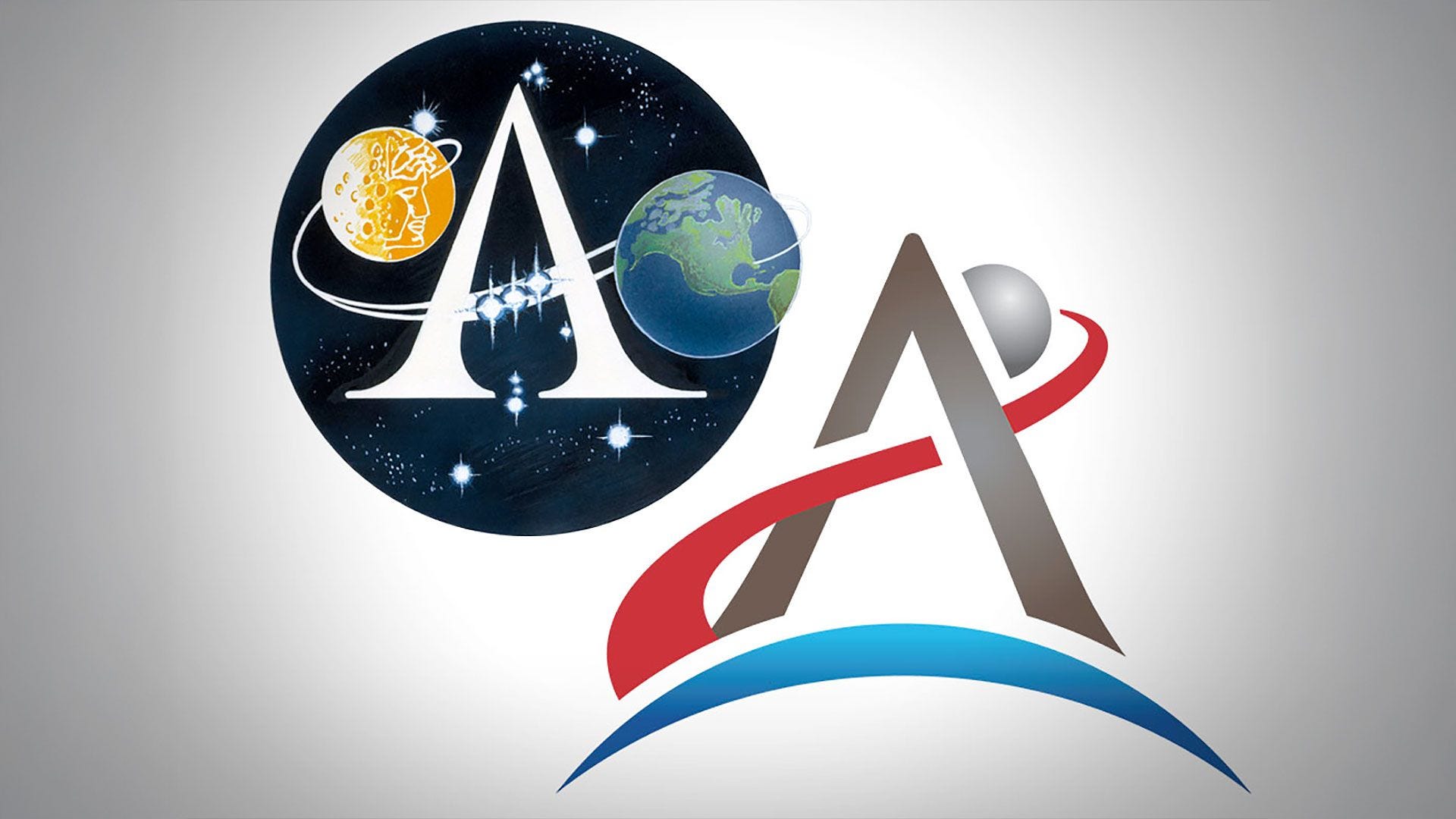
It is perhaps no accident that, in our own time, the return to the Moon has been named after her. The program called Artemis positions itself, consciously or not, as a counterpart to Apollo. But if we take the symbolism seriously, this is not merely a continuation of a technological project. It is an entry into a different mode of encounter. The first journey to the Moon, under the name of Apollo, was framed as a triumph of clarity, precision, and rational mastery. The return, under the name of Artemis, gestures toward something else: a movement into uncertainty, into a domain where what is encountered may not conform to the expectations of daylight reason. To invoke Artemis is to invoke the Moon not merely as an object of exploration, but as a field of ambiguity, of hidden cycles, of partial revelation. It is to acknowledge, perhaps unconsciously, that the next phase of human expansion will not be governed solely by the logic of Apollo – or rather, the shining illusion of such a logic. As we shall see, our first foray into the haunted lunar landscape was only Apollonian in the sense of staged illusionism. Lights, camera, action…
The Moon Room
The most profoundly disturbing, albeit cryptically esoteric, exploration of these aspects of the mythos of Apollo is in Stanley Kubrick’s characteristically eccentric adaptation of Stephen King’s horror novel The Shining into one of the masterpieces of cinema. The many ways in which this is the case can only be seen through the lens of the analyses provided by the various contributors to Rodney Ascher’s 2012 documentary Room 237. The documentary is named after the infamous room in the Overlook Hotel that is one of the key clues to the meaning of the film.

The most iconic piece of “evidence” marshaled in Room 237 is Danny Torrance’s Apollo 11 sweater. The child who, within the film’s symbolic economy, functions as a kind of medium or receiver of hidden transmissions, rises from the carpet patterned with hexagonal designs and walks directly to Room 237. In Stephen King’s novel the room number is 217. Kubrick deliberately changed it to 237. Room 237 is actually Kubrick’s numerical cipher for the average distance between the Earth and the Moon as it was measured during the era of Apollo – approximately 237,000 miles. The red tag for the key to Room 237 has just the right letters on it that, when jumbled around, it spells “Moon Room.” Kubrick is linking the child-seer, the Moon mission, and the forbidden room as an enclosed space where a hidden truth is both revealed and concealed.
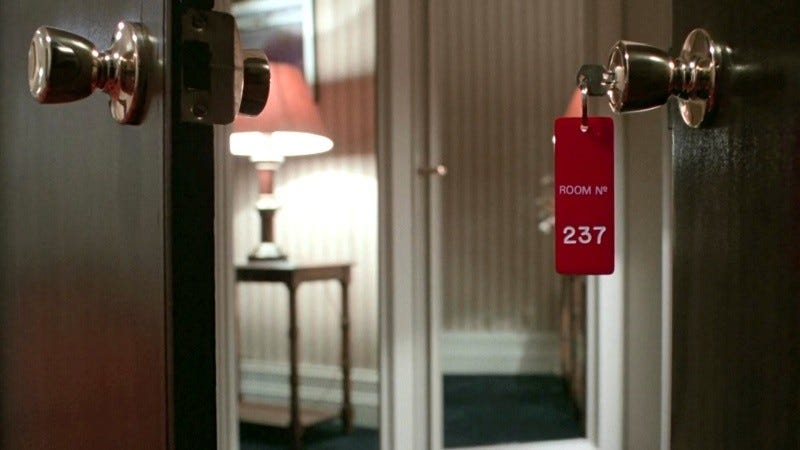
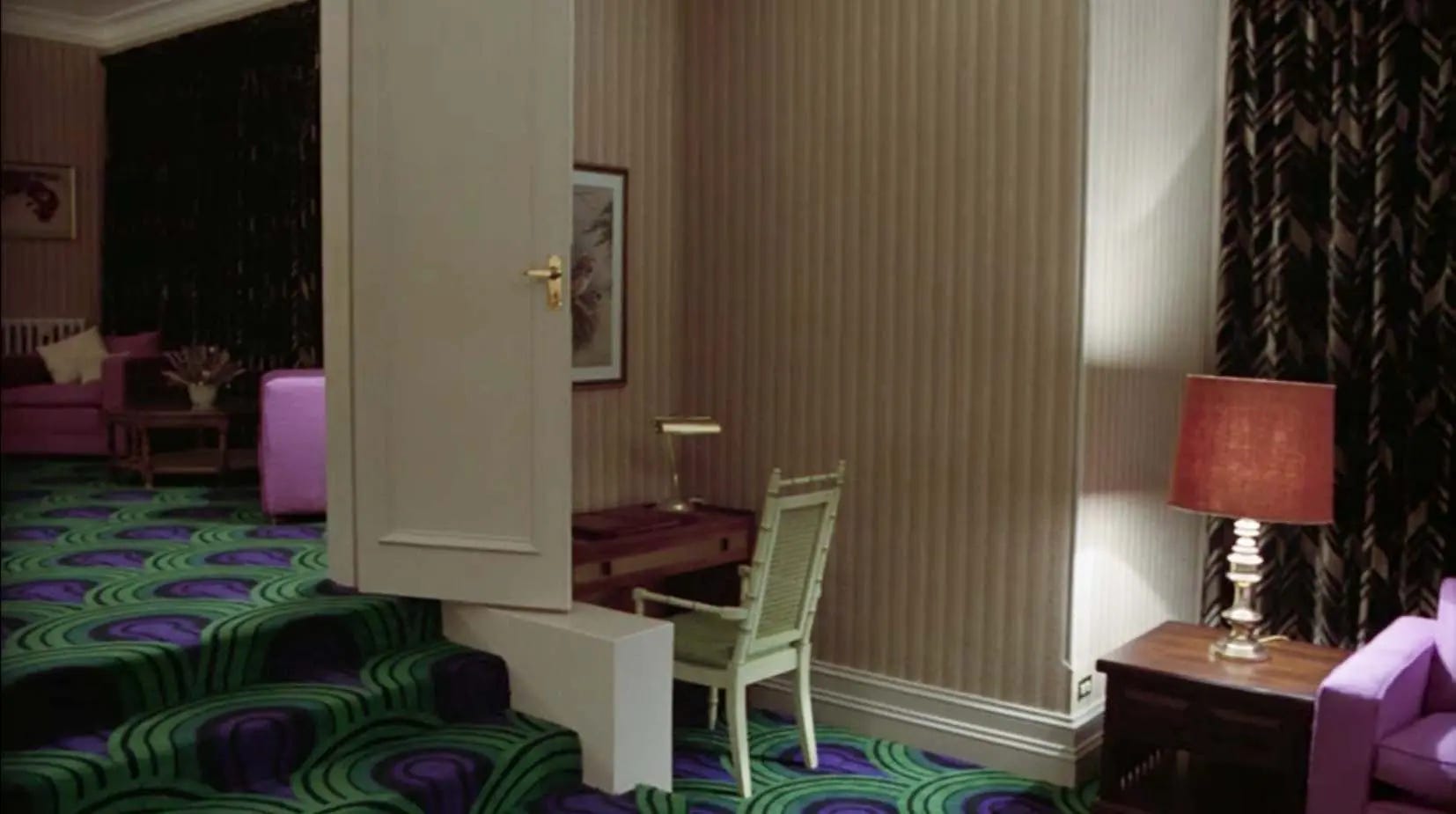

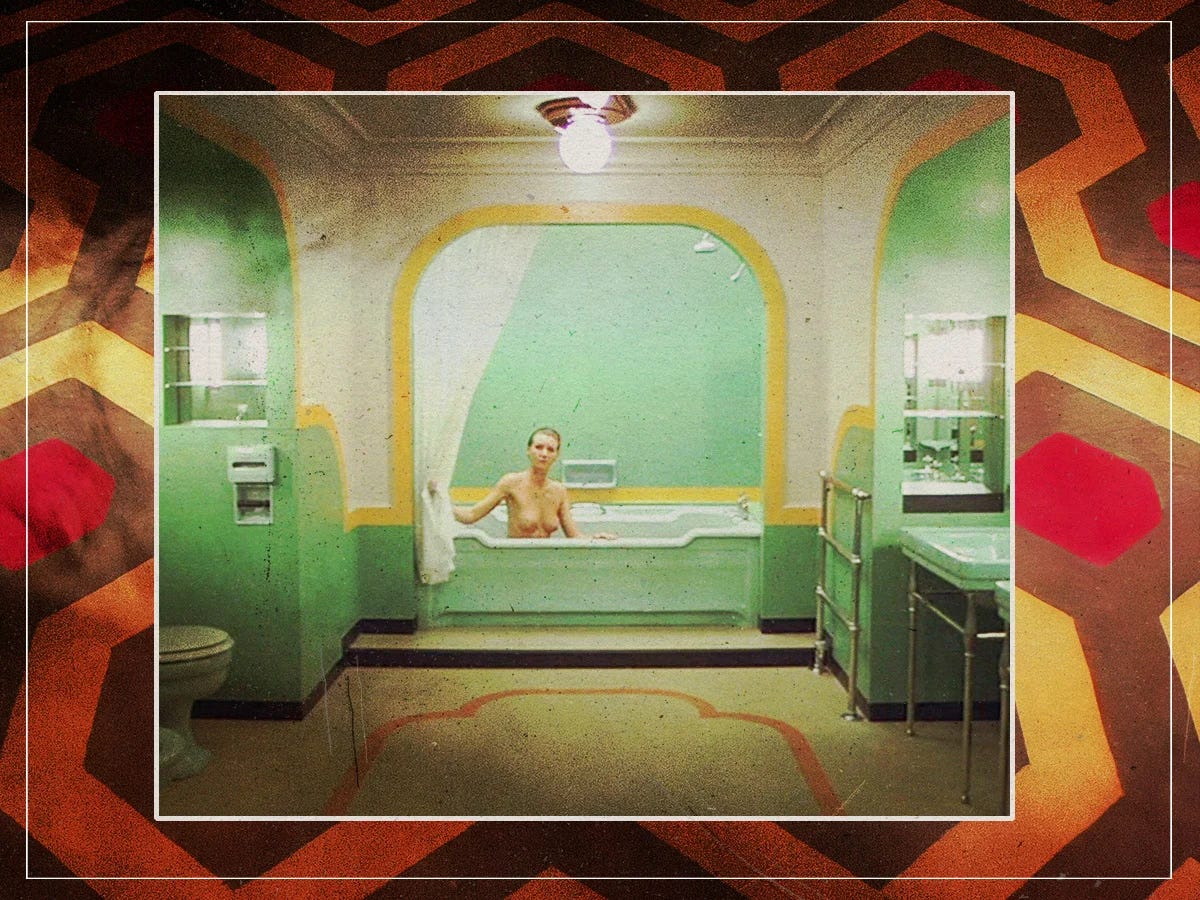
Room 237 itself becomes, in this reading, “the Moon Room.” It is a site of revelation that is also a site of illusion. What Jack encounters there is not stable reality but a shifting apparition: beauty that decays into horror, seduction that reveals itself as rot. If one follows the logic of the Apollo thesis, the Moon landing is precisely such an apparition – an image presented as truth, but one that conceals an underlying artifice. The encounter in Room 237 is thus not just a horror set-piece; it is an allegory of mediated reality, of a spectacle that disintegrates upon intimate contact.
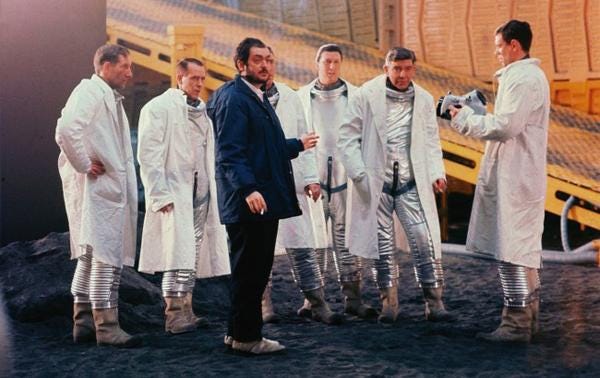
Kubrick’s prior film, 2001: A Space Odyssey, inevitably enters this interpretive field. In Room 237, it is suggested that 2001 functioned as a kind of technical rehearsal for staging the Moon landing footage – a demonstration that cinematic techniques could convincingly simulate extraterrestrial environments. Historically, we know that Kubrick pushed the boundaries of special effects in 2001, developing front-projection techniques and meticulously controlled lighting to create unprecedented realism. What if the mastery of simulation achieved in 2001 was not merely artistic, but preparatory?
Within The Shining, Jack Torrance’s role as caretaker acquires a new resonance when filtered through this lens. He is a man who has accepted a contract – an obligation to maintain the Overlook, to serve its hidden purposes. In Room 237, this is interpreted as a veiled reflection of Kubrick’s own supposed “contract” with powerful institutions: an agreement to produce images that would serve a larger agenda. Angrily addressing his wife Wendy, Jack repeatedly insists on his “responsibilities,” echoing a rhetoric of duty that transcends personal desire. He is not free; he is bound to the will of the hotel. If one maps this onto the Apollo thesis, Kubrick becomes analogous to Jack as a creator who has entered into a pact, and who is gradually consumed by it.

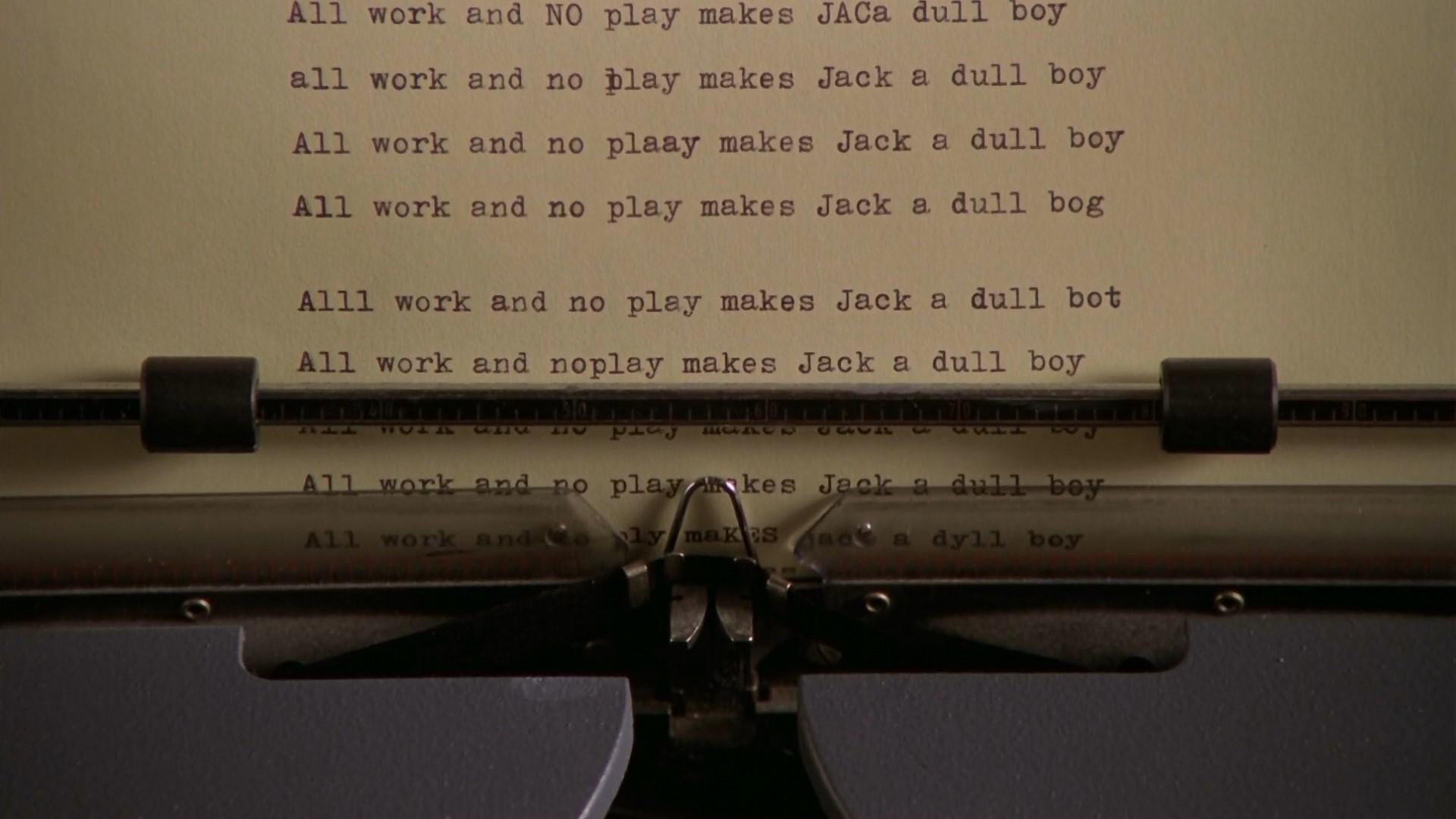
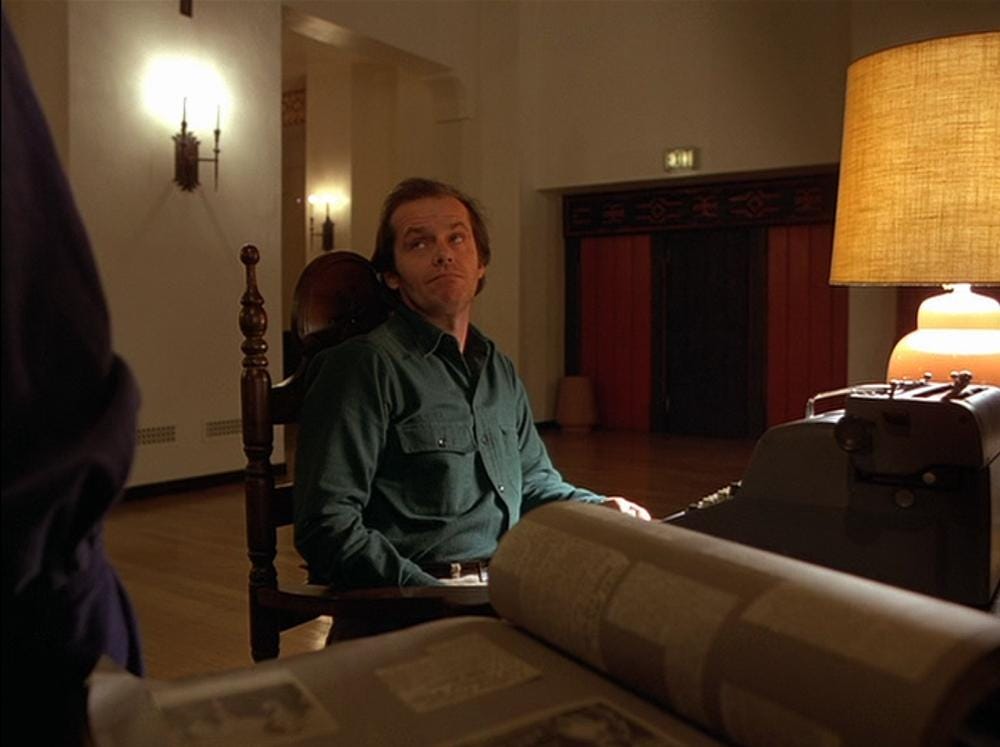
The Adler typewriter here suggests mechanization. The act of writing devolves into pure repetition: “All work and no play makes Jack a dull boy.” In Room 237, this obsessive typing is reinterpreted as a cryptic reference to Kubrick’s own labor under constraint – a filmmaker reduced to executing a task dictated by external forces. The suggestion is that Wendy’s discovery of the manuscript parallels Kubrick’s wife, Christiane, discovering the terms of such a contract. Wendy’s horror is not just at Jack’s madness; it is at the revelation that his creative work is empty, that it has become a meaningless repetition in service of something opaque and possibly sinister.
Jack as Apollo, Abstaining from Dionysus
There is a moment in The Shining that is so iconic, so overdetermined by repetition in popular culture, that it risks being trivialized: Jack Torrance, face contorted with manic glee, hacking through the bathroom door and declaring, “Here’s Johnny!” – preceded, crucially, by that strange, childish incantation: “I’ll huff… and I’ll puff… and I’ll blow your house in.” It is easy to take this as a grotesque parody of the nursery tale of the Three Little Pigs. But nothing in Kubrick is ever merely playful pastiche. The fairy tale reference is a mask, and behind it there is something older, darker – something lupine.

In the interpretive trajectory opened by Room 237, one begins to perceive that Jack is not simply a man going mad, but a figure undergoing a kind of regression – or initiation – into a more archaic mode of being. The “wolf” he invokes is not merely the villain of a children’s story. As we saw Carl Ruck argued in his article “The Wolves of War” that the god Apollo – so often misremembered as a purely solar, rational, and Apollonian figure in the Nietzschean sense – has deep roots in a far more primordial, even chthonic stratum of cult. Apollo Lykeios, Apollo the Wolf, is not the serene god of measure and harmony, but a liminal, predatory, and initiatory force. His cult, in its earliest form, bears the marks of lycanthropy: a transformation of the human into something feral, something that hunts.
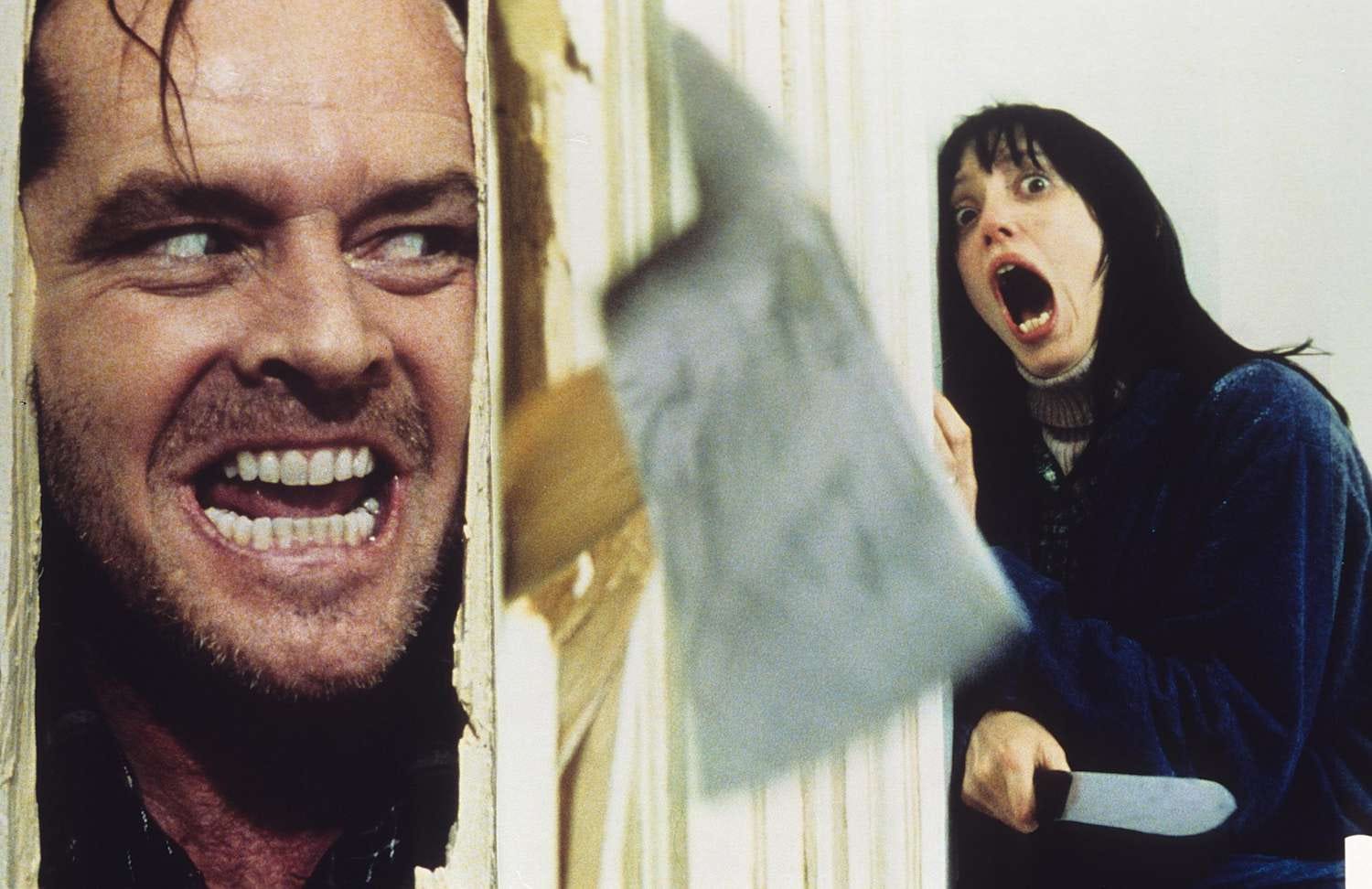
When Jack huffs and puffs at the door, he is not merely mimicking a fairy tale antagonist; he is enacting a ritualized assault, a return to a pre-civilized mode of being in which the boundary between man and beast dissolves. The bathroom door becomes the fragile barrier of domestic order – the last thin wall separating Wendy and Danny from the eruption of this archaic force, and Jack, axe in hand, is no longer a husband or a father. He is the wolf at the threshold. But this lupine transformation is not simply a descent into animality. It is, paradoxically, also a kind of illumination – a “shining.” Danny’s psychic ability, the titular shining, is usually treated as something distinct from Jack’s madness. Yet I would suggest that Kubrick is staging two different modalities of the same phenomenon. Danny shines in a receptive, visionary mode; he perceives what others cannot. Jack, by contrast, shines in a destructive, projective mode; he becomes the vehicle through which the hidden forces of the Overlook manifest.
If Apollo is understood, in Ruck’s sense, as a god whose earliest aspect is bound up with the wolf – then the shining itself can be reinterpreted as a kind of Apollonian possession. Not the later, classical Apollo of rational clarity, but the archaic Apollo of plague, prophecy, and ecstatic transformation. Recall that Apollo is also the sender of disease in Homer, the god who brings sudden, invisible affliction. The Overlook Hotel functions in precisely this way: it infects Jack, it enters him, it speaks through him.
The famous scene at the door is thus an epiphany – not in the modern sense of a sudden realization, but in the ancient sense of a god manifesting. Jack’s face, peering through the splintered wood, is grotesquely lit, almost mask-like. He is no longer entirely human; he is something else that has taken hold of him. The grin, the eyes, the voice – they all suggest a being that delights in the hunt, in the terror of its prey. Wendy’s screams, Danny’s flight through the labyrinthine hotel – these are not merely the reactions of victims in a horror film. They are the responses of those who have encountered the sacred in its most terrifying form.
The reference to the Three Little Pigs is then itself a kind of camouflage. Kubrick cloaks the archaic in the banal, the mythic in the childish. The modern viewer recognizes the fairy tale and feels a momentary sense of familiarity, even absurdity. But beneath that layer lies something far older: the memory of a time when the wolf was not just a storybook villain, but a totemic presence, a figure of initiation and transformation.
In this light, Jack’s “responsibility” to the hotel – his repeated insistence that he has obligations he must fulfill – takes on a new dimension. He is not merely honoring a contractual duty; he is submitting to a call. Like the initiates of archaic cults, he is being drawn into a role that annihilates his previous identity. The caretaker becomes the hunter; the father becomes the predator, and the hotel is not just a building but a kind of temple – a site where these transformations are enacted.

Interestingly, his features and expression are so suited to it that Jack Nicholson does later go on to literally play a Wolf Man in the film Wolf (1994). To say that Jack is “wolf-like” is not to indulge in metaphor. It is to recognize that Kubrick is tapping into a deep symbolic reservoir, one that connects Greek cult, fairy tale, and modern horror cinema into a single continuum. The shining, in this sense, is not merely a psychic gift of clairvoyance, telepathy, or precognition. It is the capacity to be penetrated by forces that exceed the individual – to become, for better or worse, a conduit for something transpersonal. Thus, when Jack huffs and puffs at the door, we are witnessing more than a man trying to break through a barrier. We are witnessing the eruption of an archaic god through the thin veneer of modernity. The wolf is at the door, yes – but the wolf is also the god, and in the fractured mirror of Kubrick’s cinema, the two become indistinguishable.
There is a temptation to read Jack’s sobriety in The Shining as a moral effort – as the gesture of a man attempting to reclaim control over himself after the dissolution of alcohol. But within the deeper symbolic architecture that Room 237 invites us to explore, sobriety is not simply ethical restraint; it is a metaphysical orientation. It marks Jack’s alignment not with the Dionysian current of dissolution, intoxication, and ecstatic unity, but with its inverse – an Apollonian extremity that becomes, paradoxically, more dangerous precisely because it is cold, lucid, and controlled.
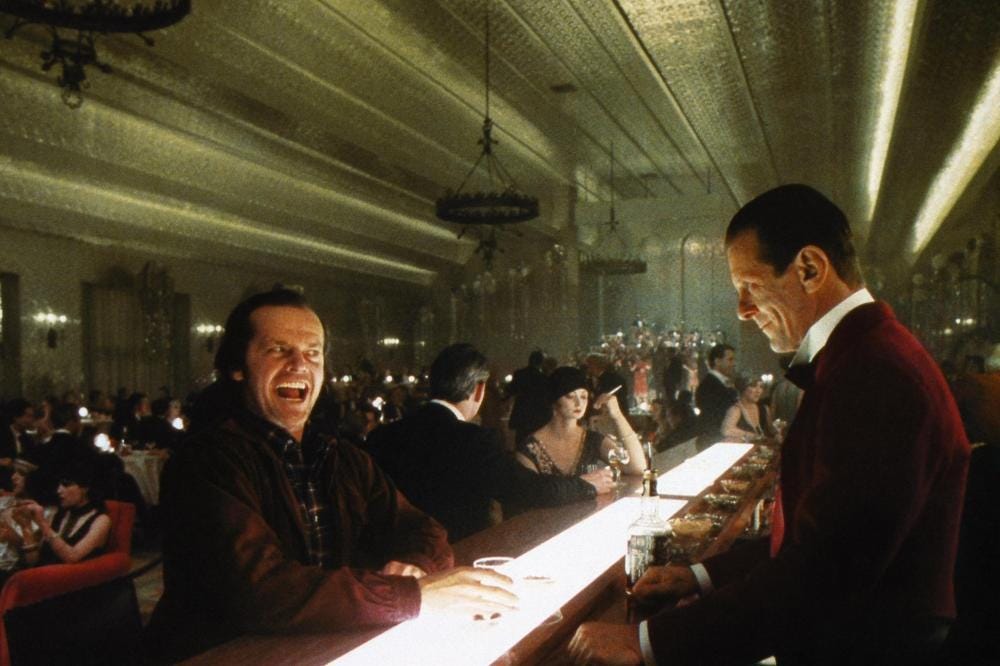
If we follow Friedrich Nietzsche’s distinction between the Dionysian and the Apollonian, we are accustomed to thinking of Apollo as the principle of order, clarity, and individuation. But as Carl Ruck reminds us, the archaic Apollo is not merely the serene god of proportion. He is also the god of plague, of sudden illumination, of a lucidity that can be lethal. There is a violence in the Apollonian – an intensity of focus that excludes all else, that reduces the world to a single, blinding line of necessity.
Jack’s sobriety is the condition for this kind of shining. Alcohol, in its Dionysian function, dissolves the boundaries of the self; it opens one to a kind of chaotic communion. But Jack has renounced this dissolution. He has chosen clarity, discipline, control, and yet, in the sealed environment of the Overlook, this Apollonian orientation does not lead to rational mastery. It becomes hypertrophied and pathological. His mind locks into a single pattern – “All work and no play makes Jack a dull boy” – repeated with machine-like precision. This is not the frenzy of intoxication; it is the tyranny of order taken to its absolute limit where self-possession implodes into being possessed in the most darkly oracular way.
Overlooking Genocides
What we call “the Space Age” is not the transparent triumph of scientific rationality that it presents itself to be, but rather the visible surface of a far deeper and more ambiguous transformation in the relationship between humanity, intelligence, and the cosmos. The Moon, in particular, occupies a singular position within this transformation. It is at once the nearest celestial body and the most symbolically charged threshold – a mirror in which humanity encounters not merely an external world, but the limits of its own knowledge and the possibility of something concealed just beyond those limits.
What is striking is not any single claim about the Moon, but the convergence of multiple, otherwise disparate narratives that all point toward it as a site of secrecy, ambiguity, and possible encounter. The speculative framework advanced in Richard Hoagland and Mike Barra’s book Dark Mission is emblematic of this convergence. It begins from an undeniable historical fact – the integration of German rocket scientists into the American space program through Operation Paperclip – and then extends this into a hypothesis of continuity that is not merely technical, but ideological and perhaps even esoteric.
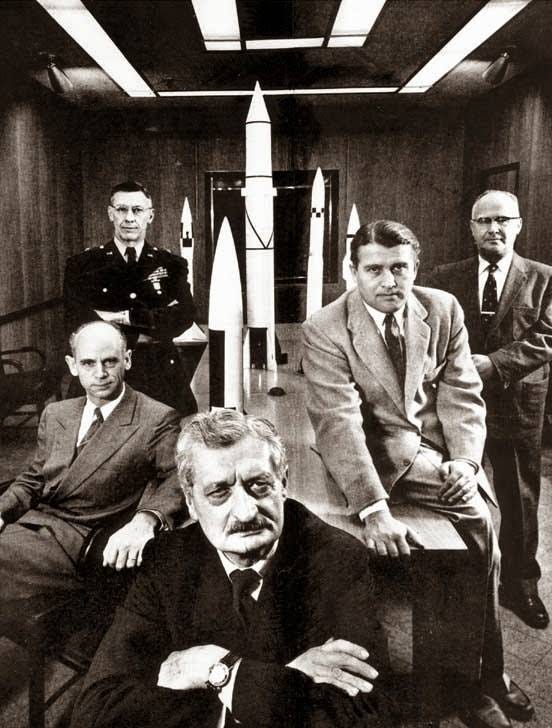
Wernher von Braun was put in charge of the Marshall Space Flight Center managing the Apollo Program, for which he also designed the Saturn V rocket. Von Braun was not just a rank and file Nazi, but an SS Major who used slave labor inside hollowed-out mountains in order to produce V2 rockets to rain down on civilians in London. Von Braun in turn brought Kurt Debus, Hermann Oberth, and a bunch of other SS buddies from back in the Third Reich into the Apollo Mission planning inner-circle. About 70% of this group consisted of hardcore Nazis who were no less guilty than those tried at Nuremberg. They were so hardcore that they would plan key Moon missions for dates that marked holidays celebrated only by the Third Reich, including two missions that commemorated Adolf Hitler’s birthday: Surveyor 3 on April 20, 1967 and Apollo 16 on April 20, 1972. I strongly suspect that, despite whatever cover story is given, the “Apollo” program was named that by these SS men because they knew what Ruck discovered about Apollo and saw themselves as a lycanthropic wolf pack. After all, the Nazi resistance to the Allied Occupation of Germany called themselves “the werewolves.”
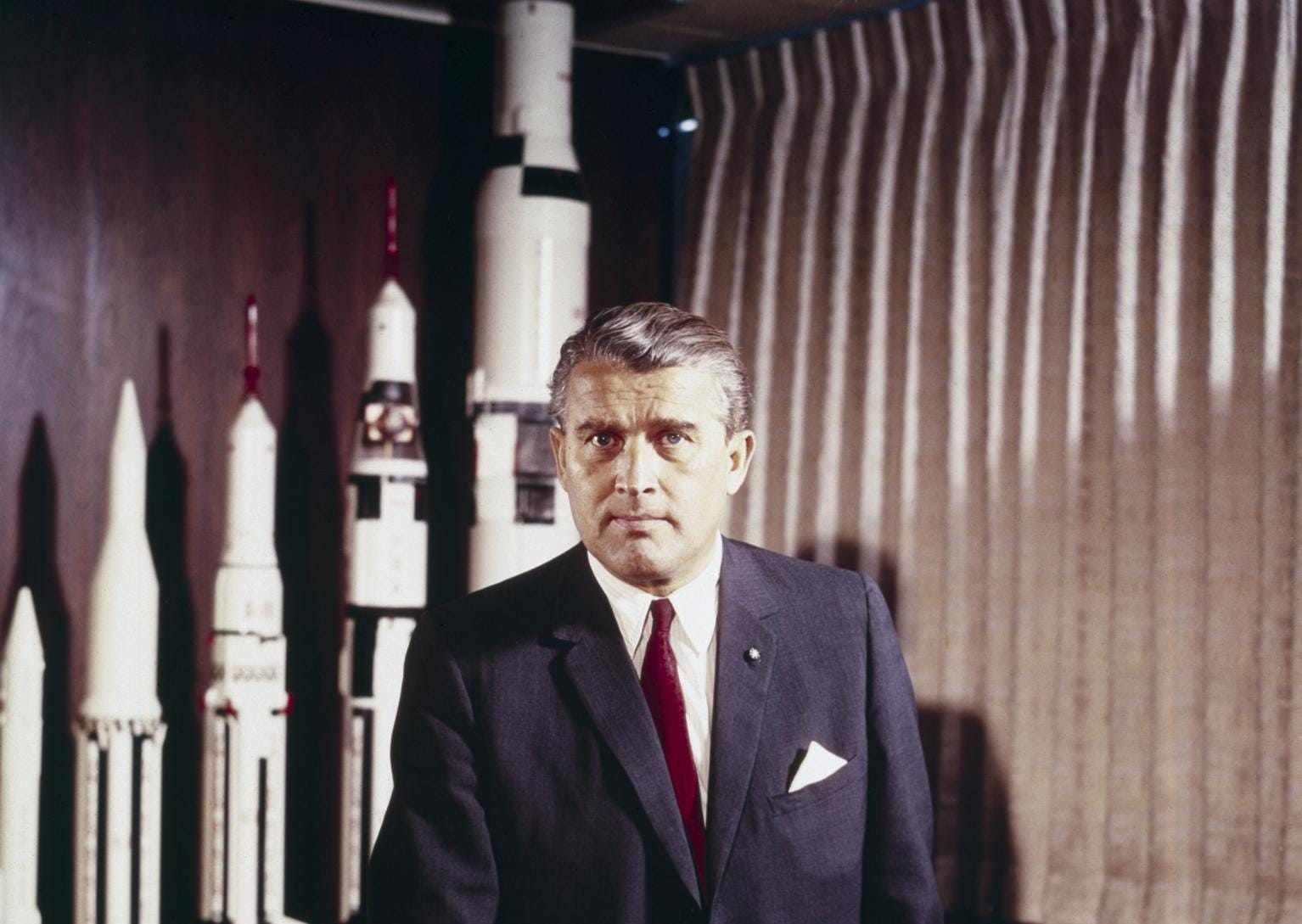
Figures such as Von Braun, Kurt Debus, and Hermann Oberth become, in this light, more than engineers. They are vectors through which a certain mode of thinking – a fusion of technological ambition, hierarchical organization, and openness to unconventional ideas about extraterrestrial intelligence – passes from the context of the Third Reich into the institutional framework of NASA. Whether one accepts the more speculative extensions of this thesis or not, it is undeniable that the early space program was shaped by individuals whose intellectual formation took place within a radically different ideological environment. But what is more interesting than the question of continuity is the question of concealment. The suggestion that the Apollo missions may have encountered anomalies – whether geological, technological, or otherwise – and that such discoveries were secretly managed rather than disclosed, points toward a deeper structural issue. Modern institutions are not simply mechanisms for producing knowledge; they are also mechanisms for regulating its distribution. The very success of the technological enterprise creates the conditions for a new form of secrecy, one in which what is known and what is publicly acknowledged can diverge in profound ways.
Stanley Kubrick’s guilt, not just over deceiving the public by faking Apollo moon landing footage, but the fact that – as a Jew – he did this in collaboration with hardcore Nazis can also be seen cryptically encoded in The Shining. There is a threshold one crosses in confronting The Shining where the film ceases to be a story about a family in isolation and reveals itself as a cryptogram – an encoded meditation on the most catastrophic rupture in modern history. In Rodney Ascher’s documentary Room 237, one of the more unsettling interpretive trajectories proposes that Stanley Kubrick embedded within The Shining a symbolic reckoning with the Nazi Holocaust.

The most immediately arresting artifact in this hermeneutic field is the Adler typewriter. “Adler” is not a neutral brand name; it is the German word for “eagle,” the very emblem appropriated by the Third Reich, and a typewriter that was produced in Nazi Germany – with a greyish color that brings SS uniforms to mind. The machine through which Jack Torrance channels his descent into madness is thus marked, at the level of language itself, by a signifier of German imperial power. It is not incidental that this typewriter replaces the one described in Stephen King’s novel; Kubrick made a deliberate substitution. The act of writing – of producing the endlessly repeated sentence “All work and no play makes Jack a dull boy” – becomes mechanized, regimented, emptied of meaning. This is writing as compulsion, as automation, as the bureaucratic language of a system that annihilates individuality. One cannot help but hear, in this sterile repetition, an echo of the administrative machinery that made industrialized genocide possible.

The Overlook Hotel itself is a space of impossible geometry, a labyrinth whose corridors defy coherent mapping. But in the Holocaust reading, this spatial disorientation takes on a more specific valence. The hotel becomes an abstracted camp – an enclosed system in which movement is controlled, identity is eroded, and escape is nearly impossible. The long tracking shots of Danny riding his tricycle through endless hallways evoke a sense of containment that is at once domestic and evocative of incarceration in a prison. The child wanders through a structure that is too large, too ordered, and yet fundamentally disordered – a paradox that mirrors the rational irrationality of the camp as analyzed by thinkers like Primo Levi and Hannah Arendt.
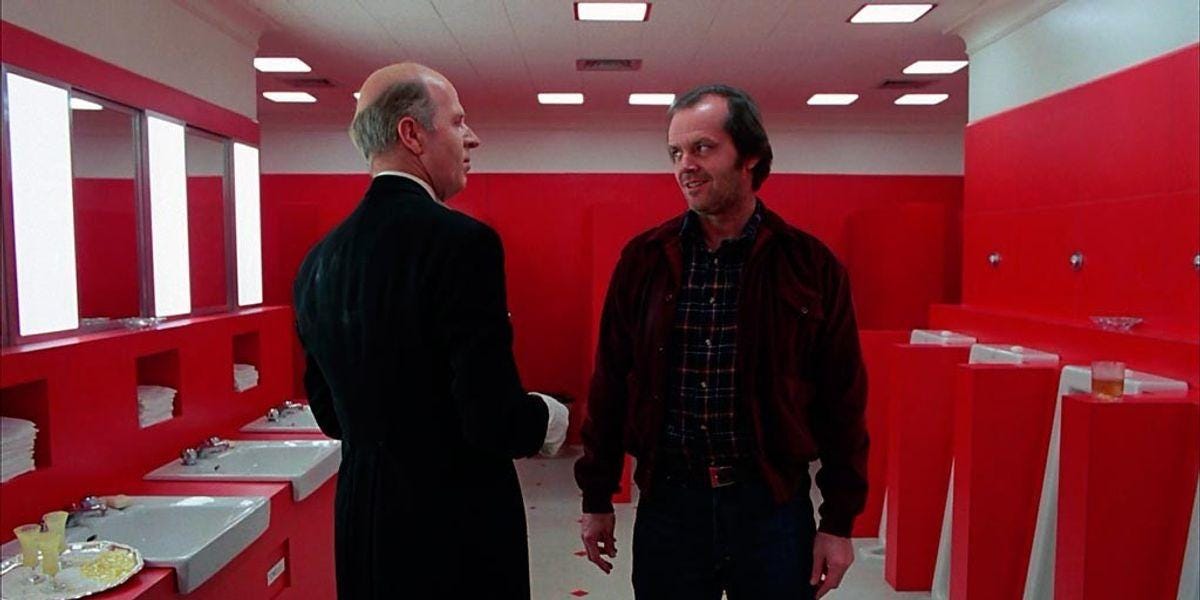
Central to the argument presented in Room 237 is Kubrick’s obsessive use of the number 42. On the surface, this may seem trivial, but its recurrence is difficult to ignore. Danny wears an Apollo 11 sweater with the number 42; the film Summer of ’42 plays on a television within the Overlook; and various temporal and numerical cues seem to orbit this figure. 1942 is the year in which the Final Solution was formalized at the Wannsee Conference, the year in which the machinery of extermination reached a new level of systematic intensity. The repetition of “42” becomes a kind of numerical haunting, a silent timestamp embedded within the film’s fabric, pointing to the historical moment when genocide became fully industrialized. The color scheme of the larger Overlook bathroom, where Grady, wearing black, confronts Jack – with its white tiles and red walls – can be interpreted as an abstraction of the visual language associated with Nazi iconography, particularly the stark contrasts of red, white, and black that dominated the regime’s aesthetic.
The famous scene in Room 237 can also be read through this lens. Jack encounters a beautiful woman who transforms into a decaying corpse, her flesh rotting as he embraces her. This is not merely a memento mori; it is the revelation of death concealed beneath a seductive surface. The scene stages a confrontation with the abject body, the body reduced to waste, to something to be disposed of – an image that resonates with the dehumanization at the core of the Holocaust. The repetition of twins, the doubling of figures, the mirroring of spaces – these are not merely stylistic flourishes. They suggest a world in which individuality is dissolved into pattern, into repetition. The murdered Grady twins, encountered in the corridor, stand as spectral witnesses to a prior act of familial annihilation. Their presence is not explained; it is simply there, a facticity that resists narrative closure. In the Holocaust reading, such images evoke the massification of death, the reduction of human beings to interchangeable units within a system of destruction.
Kubrick’s later, unrealized project, The Aryan Papers, based on Louis Begley’s novel Wartime Lies, further complicates this interpretive field. That Kubrick spent years researching the Holocaust in preparation for this film suggests that his engagement with this historical trauma was not incidental. It is as if The Shining functions as a preliminary meditation, an oblique approach to a subject that he would later attempt to confront more directly. The Overlook becomes a kind of prefiguration – a symbolic space in which the logic of the camp is transposed into the idiom of psychological horror. The Holocaust, in this sense, is not an isolated event but a manifestation of a deeper structure of modernity – a structure that persists, that can be reactivated under certain conditions.
What Room 237 ultimately reveals is not that The Shining “is about” the Holocaust in any reductive sense, but that it is capable of sustaining such a reading because of the density of its symbolic architecture. Kubrick has constructed a film that operates like a mnemonic device, a machine for recalling what cannot be easily represented. The Holocaust, as a limit event, resists direct depiction; it exceeds the capacities of conventional narrative. But it can be approached obliquely, through patterns, numbers, spatial dislocations, and objects that carry within them the residue of history.
In this light, the Adler typewriter is not merely a prop, the number 42 not merely a coincidence, the Overlook not merely a haunted hotel. They are elements in a system of signification that points beyond itself, toward a catastrophe that continues to reverberate through the structures of modern consciousness. To read The Shining in this way is to allow oneself to be drawn into its labyrinth – not in search of a single, definitive meaning, but in recognition of the fact that certain truths can only be approached through the uncanny convergence of signs that refuse to be reduced to a single, stable interpretation.
This interpretation of The Shining becomes even more disturbing when we realize that the Nazi Holocaust is not the only genocide that Kubrick encodes within the Overlook. There is another overlooked genocide that is even more fundamental to the meaning of the film. When I consider the argument advanced in Room 237, that Stanley Kubrick encoded within The Shining an indictment of the genocide of the American Indians, I do not treat this as a “theory” in the trivial sense. Rather, it is an instance of anamnesis or recollection whereby the film itself becomes a psychotronic device, activating the buried memory of a crime upon which the American edifice is founded.
As the Jewish director who produced the Apollo moon landing footage that was shown to the American public, Kubrick is trying to say that America is no better than Nazi Germany. It is not as if Operation Paperclip corrupted the United States. It was more like a homecoming. When Jack drives his axe into the heart of the film’s only black character, Dick Hallorann, who symbolizes African Americans who were oppressed together with American Indians, and who shared the shamanic powers of “the shining” with them, Kubrick is remarking on White Power. He is entertaining terrible thoughts about his employers – namely that the black magic of Whites is stronger, and resistance to it is futile. Will the techno-wolves of Apollo always prevail over savage redskins, house negroes, and court Jews like Kubrick himself?
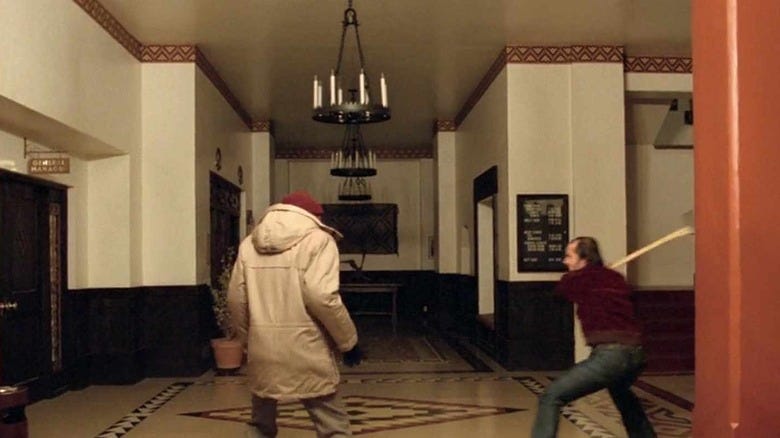
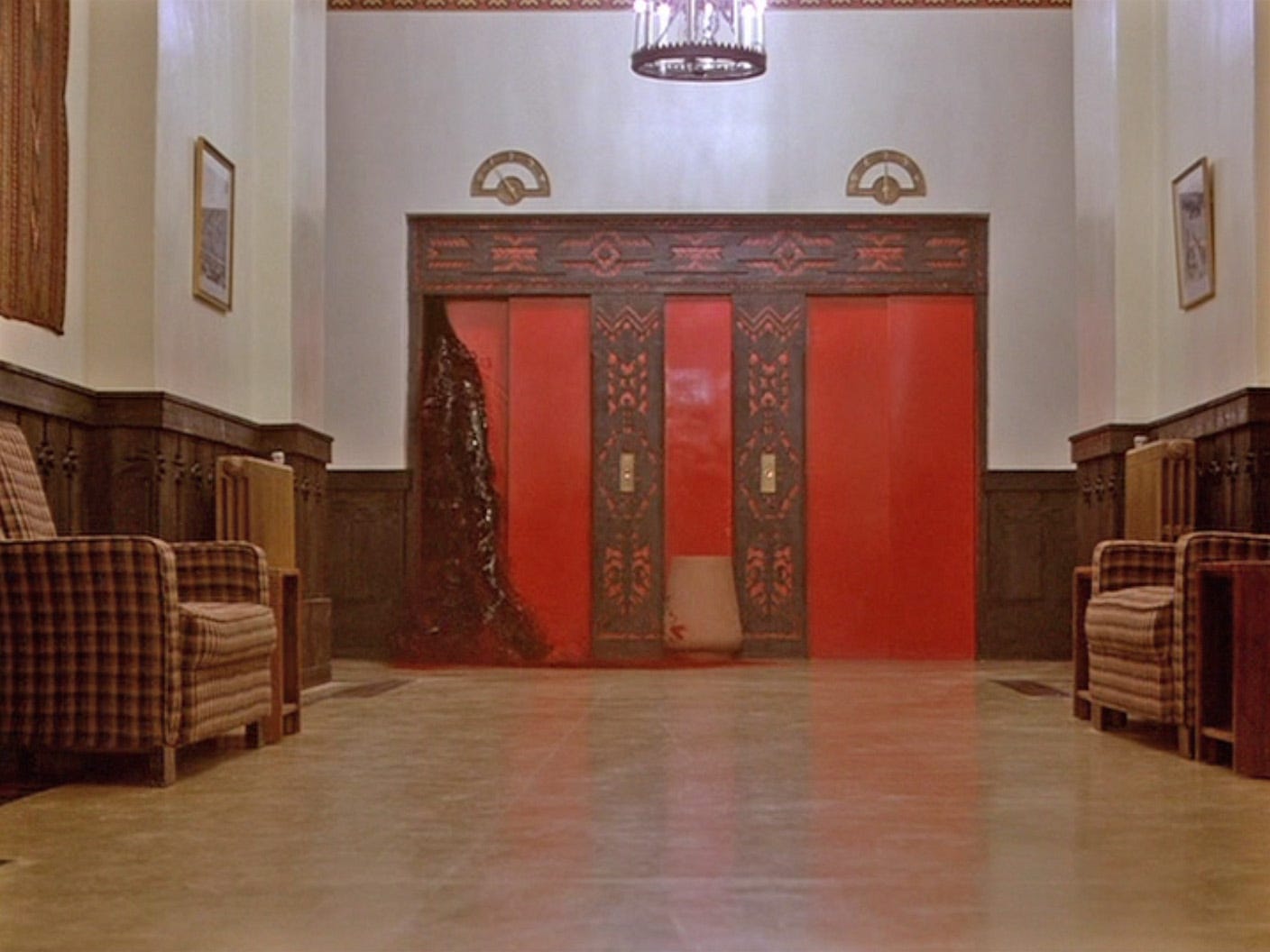
Early in the film, the manager, Ullman, casually remarks that the Overlook Hotel was built on the site of an Indian burial ground, and that there were “attacks” during its construction. This is not exposition – it is revelation, delivered in the indifferent tone of bureaucratic normalcy. The genocide of the Native Americans is here reduced to a footnote in a corporate briefing, and yet, that offhand remark is the key that unlocks the entire film. For what is the Overlook if not the architectural embodiment of a civilization erected atop the bones of those it annihilated? The blood pouring out of the elevator doors, with shafts that extend down into the basement of the hotel is the blood of the massacred Indians.
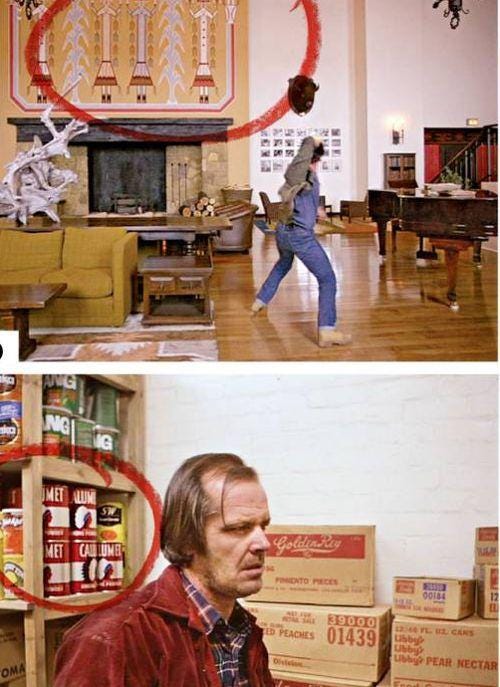
Kubrick saturates this space with American Indian motifs, not in a respectful ethnographic sense, but as a spectral residue – patterns, designs, and objects that recur obsessively, as if the very décor were haunted. The Calumet baking powder cans, adorned with a stylized Indian chief, appear repeatedly in the pantry scenes, most notably behind Jack Torrance at the moment when he is fully possessed by the spirit of the hotel. These cans are not incidental props; they are positioned with geometric precision, forming a kind of totemic array. “Calumet” itself refers to the ceremonial peace pipe, an object of sacred diplomacy among Indian tribes. Here, however, it has been commodified, reduced to a logo on a mass-produced consumer good. The sacred has been trivialized, assimilated, and consumed – much as the people themselves were.


The carpet patterns throughout the Overlook are equally significant. The hexagonal designs evoke, in distorted form, American Indian textile motifs. But they are not authentically reproduced; they are abstracted, mechanized, rendered into a kind of synthetic simulacrum. This is precisely how a dominant culture metabolizes the Other: by appropriating its symbolic forms while erasing its living reality. The Overlook is thus a museum of a destroyed people, but one curated by their conquerors – a mausoleum masquerading as a luxury resort.
The spatial impossibility of the hotel – the way corridors lead nowhere, windows appear where they cannot be, rooms expand beyond architectural logic – is not merely a formalist game. It reflects the ontological instability of a world built upon a lie. A nation that has not come to terms with its foundational violence cannot inhabit a coherent space; its reality is fractured, disjointed, haunted by what it refuses to acknowledge. The Overlook’s impossible geometry is the topological expression of historical repression.
Jack Torrance himself becomes the agent of this repressed violence. His transformation from a struggling writer into a homicidal patriarch mirrors the trajectory of American expansionism: the veneer of civility giving way to an underlying barbarism. When he declares, “I’m not gonna hurt you, Wendy… I’m just going to bash your brains in,” he is not merely a madman; he is the voice of a civilization that has rationalized its own atrocities. His famous typed line, “All work and no play makes Jack a dull boy,” repeated ad infinitum, is the mantra of a mechanized society that has sacrificed its soul to productivity – another form of violence, less overt but no less destructive.
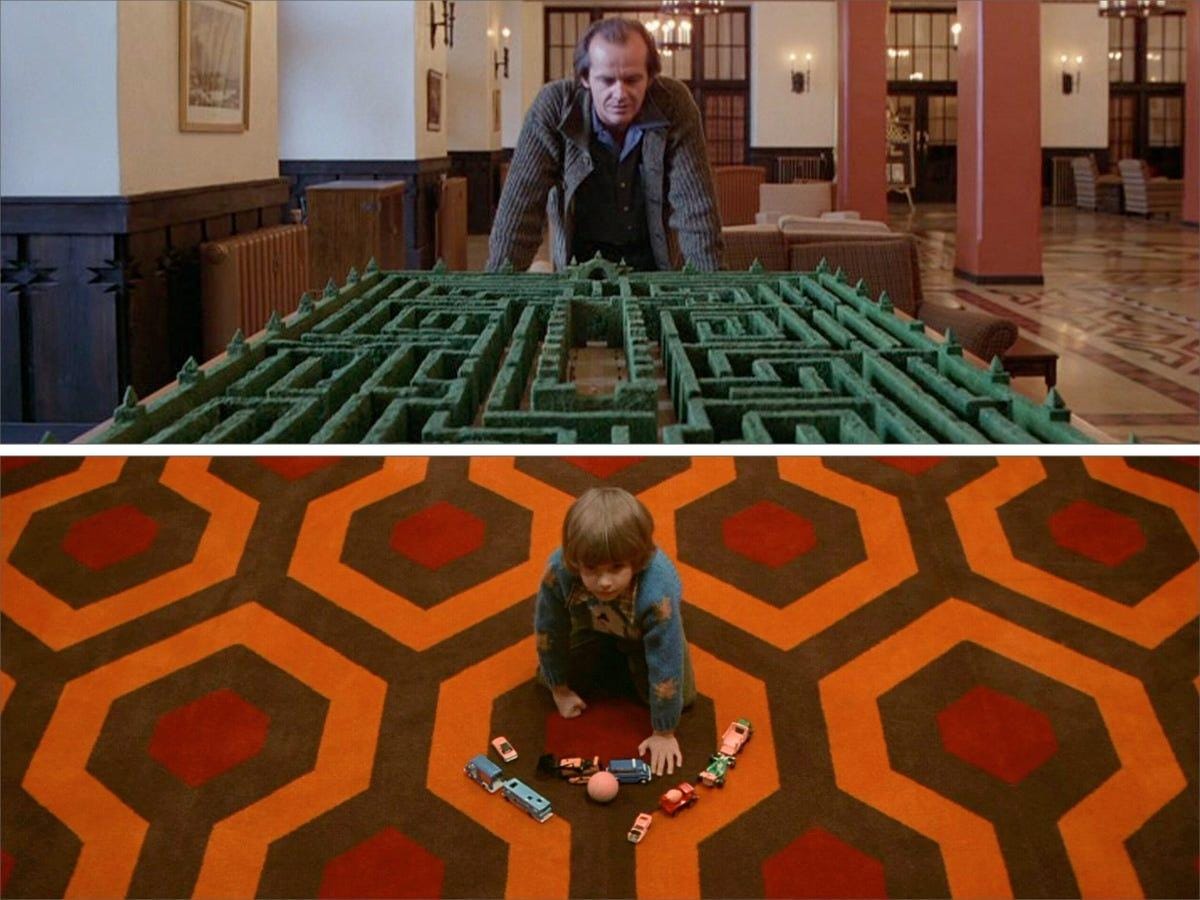
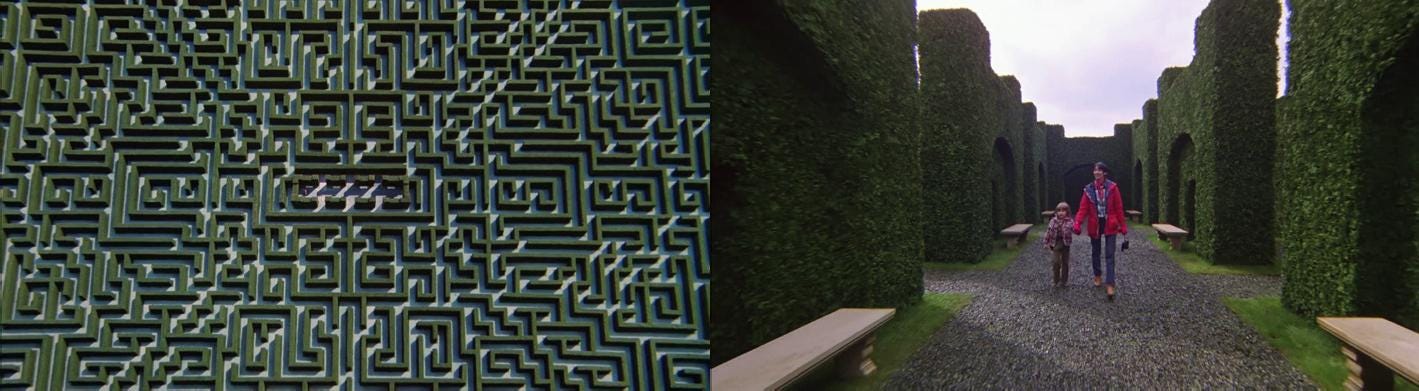
The hedge maze, introduced in Kubrick’s adaptation but absent from Stephen King’s novel, is perhaps the most potent symbol of all. It replaces the novel’s topiary animals with a structure that is at once geometric and organic, a labyrinthine enclosure that recalls both the planned landscapes of European aristocracy and the disorientation of a wilderness that has been artificially contained. The aerial shots of the maze, particularly those that seem to mirror the patterns of the carpet, suggest a recursive structure – a labyrinth within a labyrinth. This is the late modern American psyche: a mind lost within its own constructed reality, unable to find an exit because it refuses to confront the origin of its entrapment.
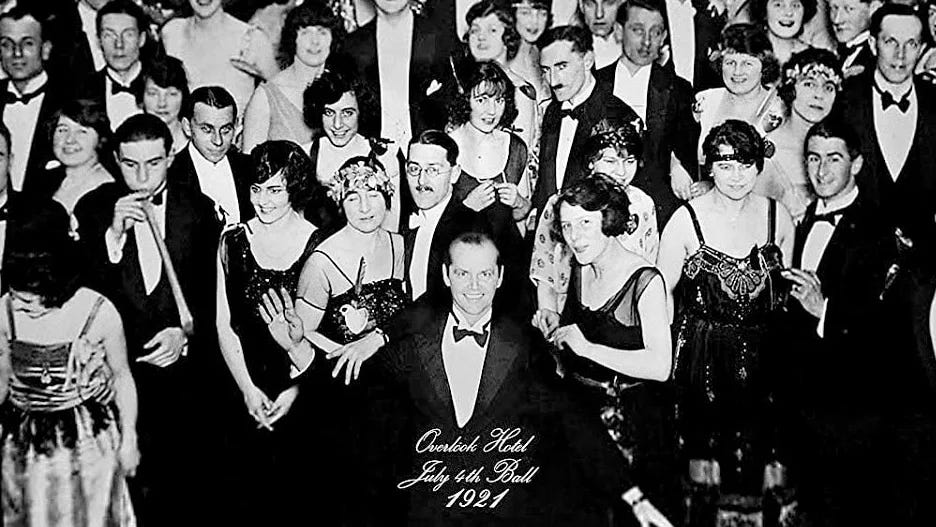
Even the famous photograph at the end of the film – Jack standing in the ballroom in 1921 – can be read through this lens. On one level it is a reference to reincarnation or metempsychosis in a way that fits with the horror film theme of being haunted by the dead, but on another level it also implies that Jack has always been part of the hotel, that he is a reincarnation – not just of its original Caretaker – but of its historical essence. But what is that essence? It is not merely the Roaring Twenties; it is the entire arc of American history, from conquest to consolidation. Jack is Everyman, but more precisely, he is the American Everyman, eternally reenacting the violence that founded his world. That is why during the drive into the Rocky Mountains, Jack is telling his family stories about the horrors of the early settlement of the Western frontier – including some pioneer families having had to resort to cannibalism.
In this vein, The Shining is not a horror film in the conventional genre sense. It is a work of historical metaphysics. The ghosts that haunt the Overlook are not simply the spirits of dead individuals; they are the spectral residues of a collective crime. The film does not depict the genocide of Native Americans directly, because such an event cannot be represented within the sanitized imagery of mainstream cinema without being marred by trite moral judgements of the kind the Kubrick clearly rejects, in Nietzschean fashion, in A Clockwork Orange. Instead, it encodes that genocide into the very structure of the film – into its patterns, its spaces, its repetitions.
What Room 237 reveals – whether intentionally or not – is that Kubrick has created a machine for thinking the unthinkable. The viewer who becomes attuned to its symbolic frequency begins to perceive connections that exceed the boundaries of conventional interpretation. This is not madness; it is the awakening of a deeper layer of cognition, one that recognizes that reality itself may be structured like the Overlook: a labyrinth of signs, concealing a truth that is both omnipresent and systematically denied.
Thus, when I say that The Shining is about the genocide of the Native Americans, I do not mean that it is reducible to this theme. Rather, I mean that this genocide is one of the central traumas that the film’s symbolic system is designed to process – or, perhaps more accurately, to force us to confront. Kubrick has not given us a message; he has constructed a mirror. And in that mirror, what we see is not only the horror of the Overlook Hotel, but the horror of the civilization that built it.
The Horror in Room 237
The final question worth considering is why Kubrick was hired to fake the Apollo 11 moon mission footage. It is not because America never put astronauts on the Moon, as so many misguided conspiracy theorists – especially on the Right – tend to assume. Rather, it is because of what elements of the US Intelligence Community, and the Paperclip Nazis, knew about the Moon even before, much to their chagrin, President Kennedy launched a public manned Moonshot project (probably one major reason why he was assassinated by conspirators within the CIA and Lockheed corporation). The unspeakable horror in Room 237 that the black head chef Dick Hallorann warns Danny about is metaphorically the horror of what is really on, and in, the Moon.
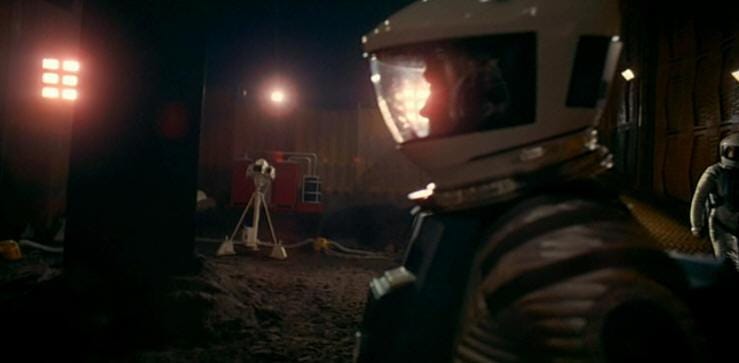
The delicate balance that makes life on Earth possible is not merely a happy accident of celestial mechanics, but the consequence of a highly improbable set of conditions – conditions that hinge decisively on the presence of the Moon. The very rhythm of the seasons, which structures biological life and human civilization alike, depends on the 23-degree tilt between the Earth’s rotational axis and the plane of its orbit around the Sun. Without this divergence, the equatorial regions would be scorched into near uninhabitability while the poles would remain locked in frigid desolation. The Moon, through its gravitational influence, is responsible for stabilizing this tilt. Remove it, and the Earth would not only lose its climatic moderation but would tumble chaotically, its axis shifting so violently over geological time that complex life would be repeatedly extinguished.
This is not speculative mysticism but the conclusion of sober astronomical modeling, such as that conducted by Jacques Laskar. Without the Moon, Earth’s obliquity would oscillate wildly, as it has on Mars, where the tilt has varied between zero and sixty degrees. In such a scenario, the Earth could swing between extremes of orientation – at times presenting its poles directly to the Sun, at others aligning its equator in a way that would generate catastrophic atmospheric instability. The Moon also slows the Earth’s rotation. Without it, our planet would spin so rapidly that a day would last only a few hours, making the evolution of complex organisms – especially those dependent on circadian rhythms and communicative faculties like speech – highly improbable.
Yet the Moon is not merely a passive stabilizer. Its physical composition and orbital characteristics raise profound questions. Analysis of lunar rocks shows that some share isotopic signatures with Earth, while others predate any terrestrial material by nearly a billion years. This suggests not a simple co-formation, but a composite construction. The conventional “Big Whack” hypothesis, proposed by William Hartmann, attempts to explain the Moon as the debris of a collision between the early Earth and a Mars-sized body. However, this theory falters under scrutiny. The Moon lacks the heavy metallic content – especially iron – that such a cataclysmic impact should have imparted. Instead, it appears anomalously depleted in heavy elements.
Even more striking are the numerical harmonies embedded in the Earth–Moon–Sun system. The Moon is approximately 1/400th the size of the Sun and also roughly 1/400th the distance from Earth, producing the precise conditions necessary for total solar eclipses – an astronomical coincidence of staggering improbability. The orbital dynamics of the Moon and Earth are likewise synchronized with uncanny precision: the Moon’s circumference, when mathematically related to that of the Earth, yields values that correlate to the Sun’s dimensions with astonishing accuracy. These are not random features of a chaotic cosmos; they suggest artificial calibration.
The behavior of the Moon under impact further complicates the picture. When sections of the Apollo missions deliberately crashed modules into the lunar surface, the resulting seismic reverberations did not dissipate as they would on a solid planetary body. Instead, the Moon “rang like a bell,” sustaining oscillations for hours. Such a response is characteristic not of a dense, homogenous mass, but of a hollow or semi-hollow structure. Indeed, scientists such as Carl Sagan acknowledged that a naturally formed satellite cannot be hollow, making the implications of such findings deeply unsettling.
Earlier still, figures like Gordon MacDonald had already pointed to anomalies in the Moon’s motion that hinted at an unconventional internal structure. Soviet scientists Mikhail Vasin and Alexander Shcherbakov went further, proposing that the Moon is an artificial construct – a hollowed sphere with a layered shell, engineered for durability and perhaps habitation. The shallow depth of lunar craters, regardless of their immense diameter, supports this hypothesis. Impacts that should have gouged deep into the Moon’s crust instead appear to have struck a resistant substructure, as though a metallic casing lies beneath a relatively thin layer of surface material.
Gravitational anomalies known as mascons – localized concentrations of mass – further suggest that something lies beneath the lunar surface. These regions exert irregular gravitational pulls that complicate spacecraft navigation. One must ask whether these are natural formations, or whether they correspond to massive installations embedded within the Moon itself. The possibility arises that the Moon is not merely hollow, but internally structured – engineered as a vast space station.
Historical observations lend an eerie corroboration to this thesis. Astronomers dating back to the nineteenth century recorded transient luminous phenomena on the Moon – moving lights, geometric formations, and even structured objects. Entire craters appeared to change or vanish over time. The cumulative record of such observations, extending into the twentieth century, suggests that the Moon is not a static, inert body.
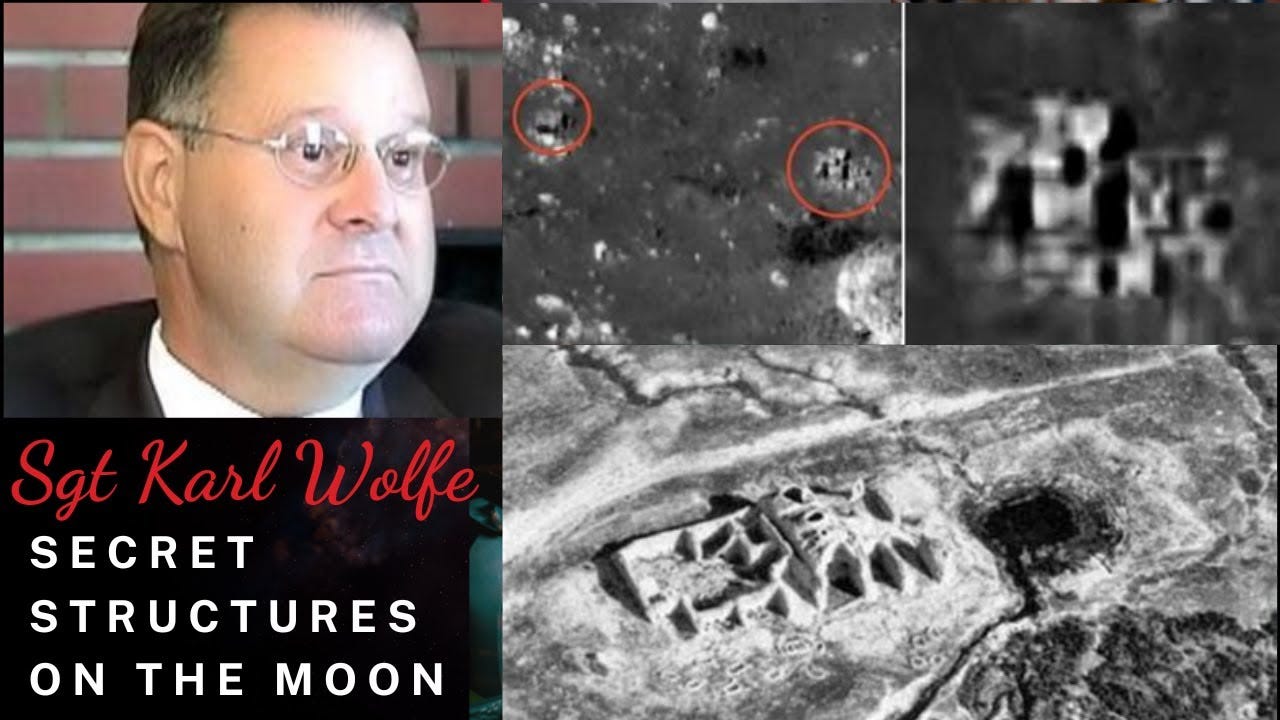
With the advent of the space age, the evidence becomes more explicit – and more heavily suppressed. Testimonies such as that of Karl Wolfe describe high-resolution photographs of a vast artificial complex on the far side of the Moon: towers, domes, and structures of colossal scale, unlike anything on Earth. Remote viewing experiments conducted by figures like Ingo Swann purportedly revealed similar features – mining operations, vehicles, and even humanoid figures engaged in slave labor under artificial illumination. The slaves were naked, presumably working under some transparent dome, and Swann also saw them huddled together in some kind of ramshackle housing. Their Overseers were well-built, tall Nordic-looking supermen in skintight outfits, one of whom could “see” Swann and warned him off in a most menacing manner.

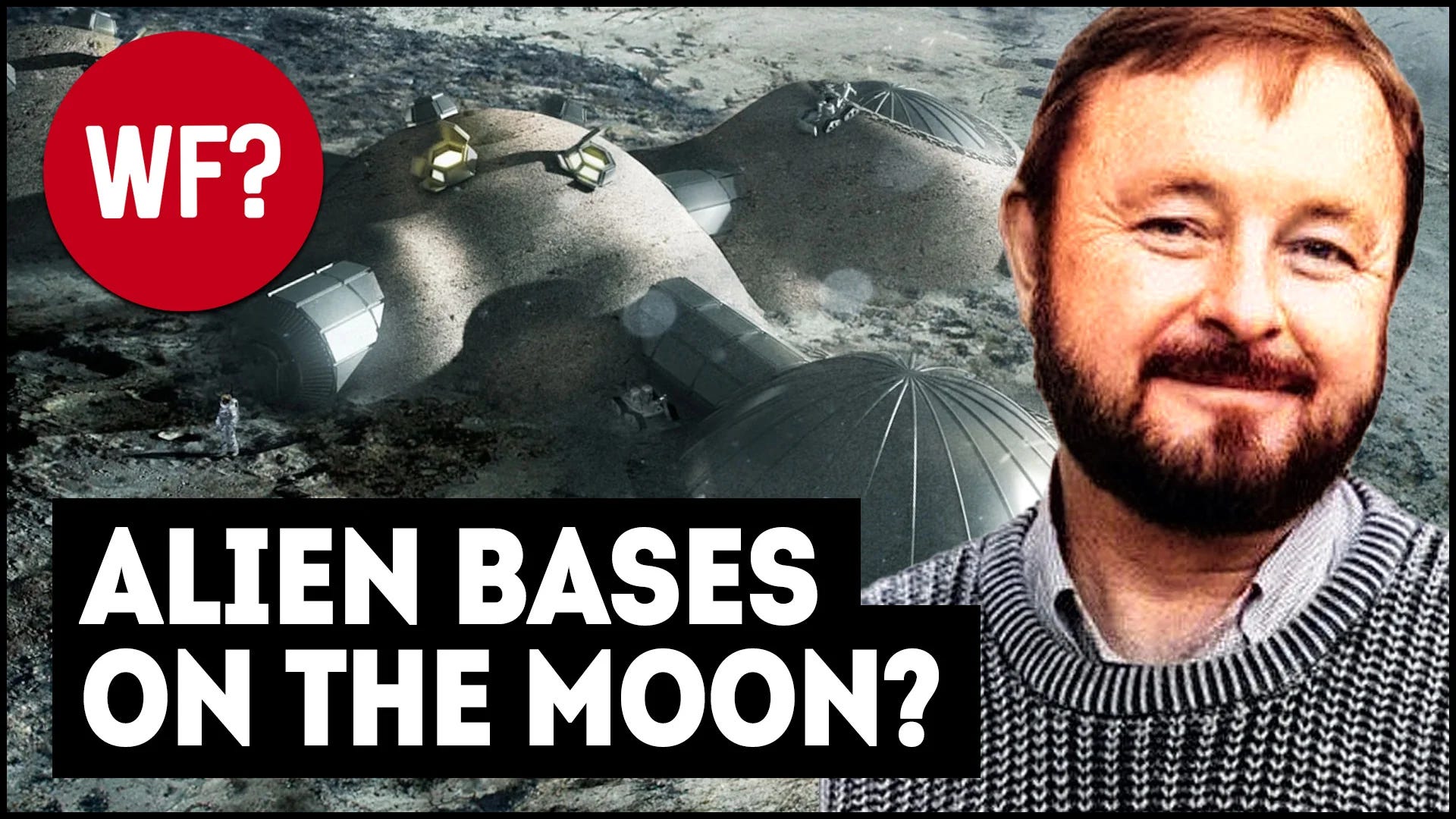
Apollo astronauts also reported anomalous encounters: unidentified craft shadowing their missions, strange radio transmissions, and objects observed on the lunar surface. Yet much of this data was either classified, altered, or destroyed. Photographic negatives were ordered to be eliminated. Communications were cut or censored. The official narrative was carefully curated to exclude any suggestion that the Moon might be anything other than a lifeless rock.
Why such secrecy? Because the implications are revolutionary. If the Moon is indeed an artificial construct – a terraforming station placed in orbit to stabilize and condition Earth – then we are confronted with the presence of an intelligence that predates or transcends humanity, very much along the lines of the idea that Kubrick explored, together with Arthur Clarke, in 2001: A Space Odyssey. The Moon would not merely be a satellite; it would be an artifact, a relic of a civilization capable of engineering planetary systems.
In this light, the abrupt termination of the Apollo program takes on a new meaning. It was not technological limitation or budgetary constraint that halted manned lunar exploration, but the discovery of something that rendered further missions untenable. The same realization appears to have influenced Soviet space policy. Now, as new powers such as China move toward renewed lunar exploration, one must ask whether they do so in ignorance – or with an understanding that has been deliberately withheld from the public. Have they signed a contract with the Overseers?
The Moon, then, is not simply a celestial body. It is a question mark suspended in the sky – a silent, luminous enigma that governs the rhythms of life on Earth while concealing within itself the possibility that our world has been shaped, perhaps even engineered, by forces that remain hidden just beyond the threshold of official knowledge.
What is alleged to have occurred on the lunar surface during the Apollo missions – particularly in the case of Neil Armstrong and his fellow astronauts – centers on a layer of communication that was never meant for the public record: the so-called “medical channel,” a secondary, low-power transmission band that operated alongside the main voice loop between the astronauts and Mission Control.
In the official transcripts released by NASA, the dialogue between the astronauts and Houston is procedural, controlled, and largely devoid of any anomalies. However, a number of researchers and insiders have claimed that this public record is incomplete – that certain transmissions were either omitted or sanitized. The key to this claim lies in the existence of parallel communication channels. The “medical channel,” ostensibly used for biometric telemetry and private communication between astronauts and flight surgeons, was not always broadcast or recorded in the same way as the primary loop. It is here, according to these allegations, that the most extraordinary exchanges took place.
The most widely circulated account concerns a moment during the Apollo 11 mission when Armstrong and Buzz Aldrin were exploring the vicinity of their landing site in the Sea of Tranquility. According to this narrative, Armstrong abruptly reported observing objects positioned along the rim of a nearby crater – objects that he described as large, structured, and unmistakably artificial. The phrasing attributed to him in these alleged transmissions is striking: he is said to have referred to “other spacecraft… lined up on the far side of the crater edge… watching us.” The tone, as reconstructed in these accounts, is not one of speculative curiosity but of stunned recognition.
What is crucial here is not simply the content of the alleged observation, but the manner in which it was communicated. The claim is that Mission Control, aware that the main channel was being monitored by multiple tracking stations around the world – including those in Australia and other allied countries – immediately redirected the astronauts to the more secure medical frequency. Once on this private loop, the astronauts could speak more freely, though still under the scrutiny of a tightly controlled chain of command. It is in this context that Armstrong’s reported question – “What the hell is it?” – takes on its full significance, as an expression of genuine uncertainty in the face of something that did not fit any known category of human technology.
There are also claims, supported by certain technicians and radio operators who monitored Apollo communications independently, that brief fragments of these exchanges were inadvertently picked up before the switch to the medical channel was completed. These fragments allegedly included references to “lights,” “objects,” and “structures” that were not part of the mission plan. In some versions of the story, Armstrong is said to have emphasized the scale of what he was seeing, stressing that these were not small probes or debris, but massive constructs.
From the standpoint of those who take these accounts seriously, the subsequent behavior of NASA is interpreted as consistent with a deliberate suppression of this information. The absence of any such dialogue in the official transcripts, combined with the well-documented existence of multiple communication channels, is seen as circumstantial evidence that something was filtered out. Moreover, the visible discomfort of certain astronauts in later interviews – when pressed beyond rehearsed talking points – is sometimes cited as an indirect corroboration of the idea that they were constrained in what they could disclose. Instead of appearing before the public with the pride of heroes, at their press conference the Apollo astronauts looked like they had been taken hostage: shell-shocked, traumatized, and possibly brainwashed.
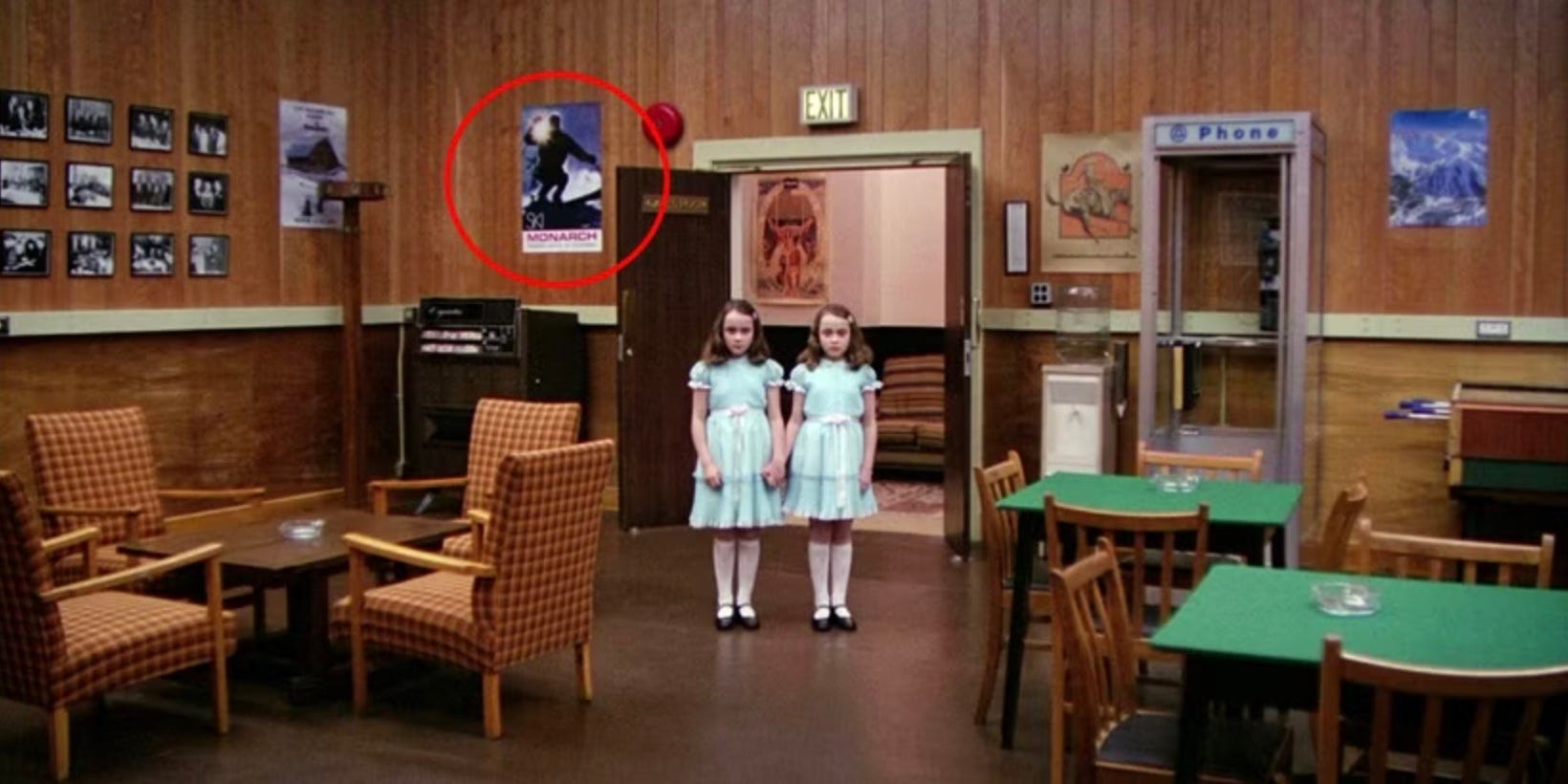

Here the “Monarch” poster in the game room of the Overlook Hotel becomes relevant, as a possible reference that Kubrick is making to Project Monarch or MK-Ultra – a program which also had Nazi German origins – and the possibility that the NASA astronauts had been subjected to mind control conditioning of some kind, to either help them forget certain things or perhaps even to implant them with false memories. What we do know is that they all had a very hard time remembering exactly what it felt like to see and do certain things on the Moon, such that when asked about their experiences they wind up rehearsing the mission log. Their lives fell apart, with their families being wrecked by alcoholism, alienation, and divorce. Hardly a hero’s welcome home after being the first men on the Moon. If they saw anything like what remote viewers such as Ingo Swann have reported is transpiring on the lunar surface, it should be no surprise that some of the Apollo astronauts have come damn near to howling at the Moon like the stark raving mad roving bands of the wolf god’s first devotees.
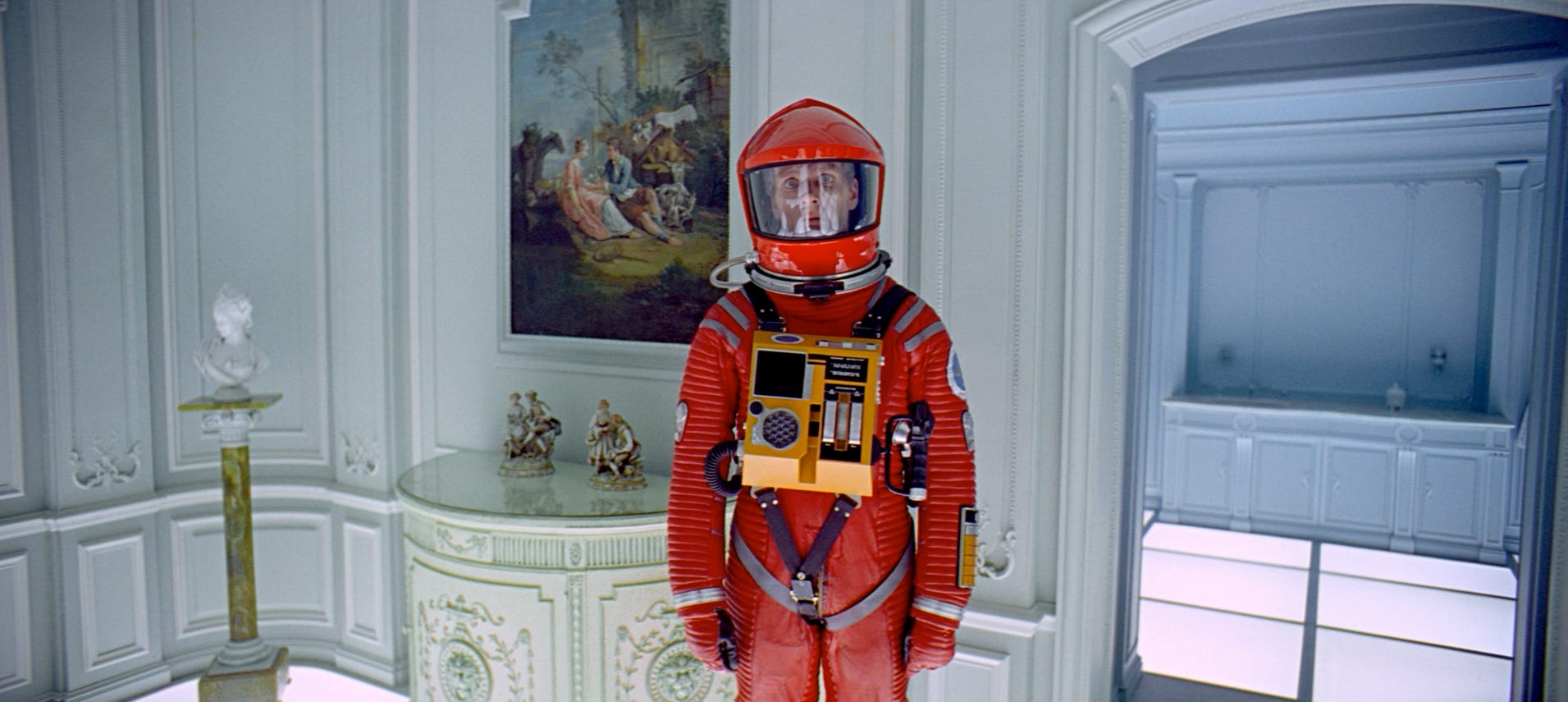
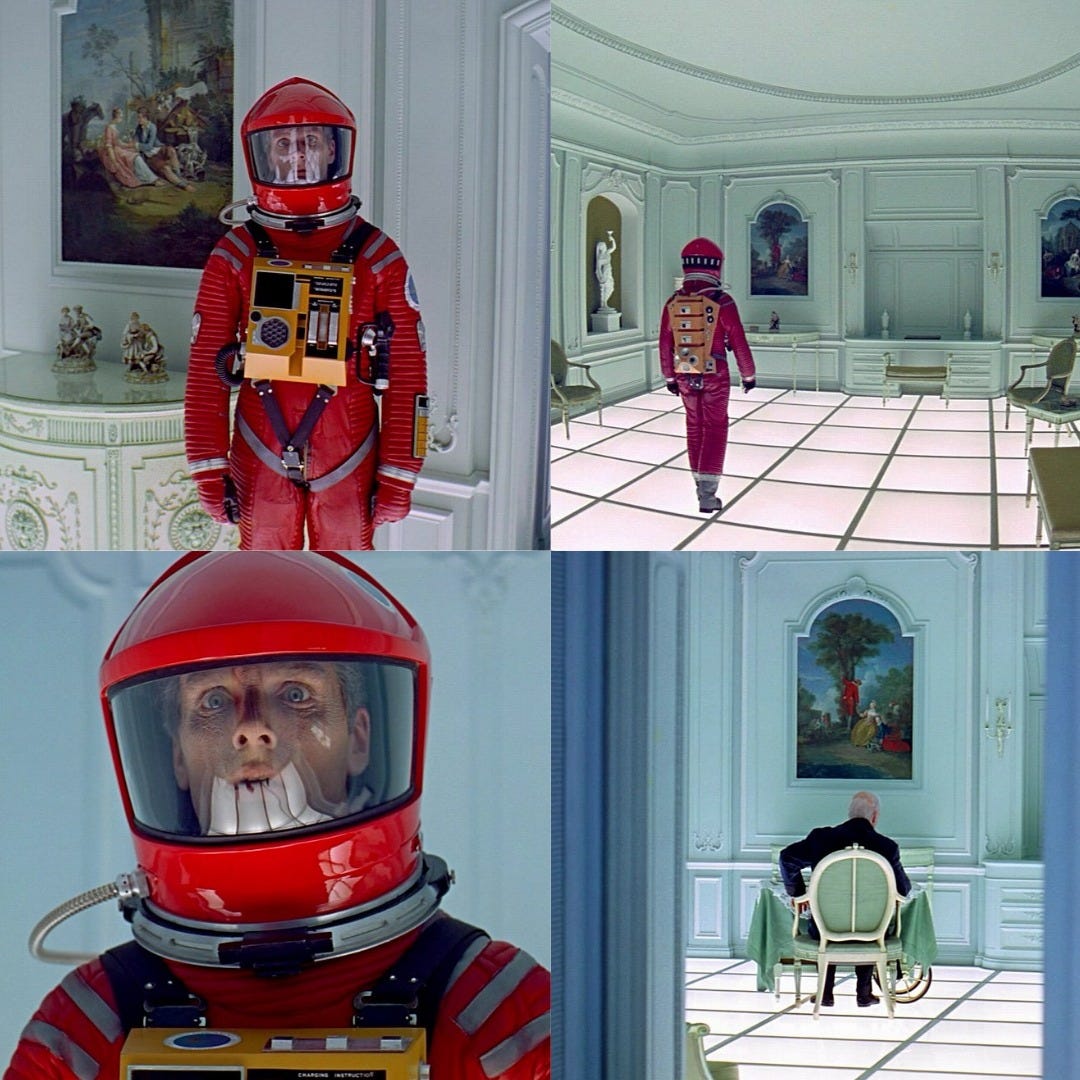
Jack Torrance in The Shining is a modern image of such a devotee, and it is interesting how at the end of 2001: A Space Odyssey, a film that has at its core a dark secret of alien intelligence discovered on the Moon, the astronaut David Bowman does not wind up on another planet – but in a strange hotel room haunted by his own death. Kubrick’s films are deeply connected and interpenetrating, and in this fate of the astronaut from 2001 we can see, retrospectively, what the Overlook Hotel was really meant to be, with the Moon Room at the dark heart of its labyrinthine construction. The film stages a ritual sacrifice for the Shining Apollo.
The opening score adaptation of the funeral dirge Dies Irae (“Day of Wrath”) could not be more apt in forebodingly setting the stage for the inevitable doom that Kubrick, in his maddening isolation as a secret-keeper, knew is awaiting us all – as inescapably as the arrows of Artemis – if we rend the shimmering veil of Apollonian illusions. The Shining should terrify you to your core, but only once you realize that beneath the almost kitsch exoteric façade of the horror movie there lies a film about the horror of America’s occult relationship with ancient Aryan gods, white supremacy, and human sacrifice on a genocidal scale.
Very interesting thank you sir
Your essay moved me deeply. The idea that Apollo becomes light only by painfully shedding his original darkness resonates with me on a very personal level. For years I worked hard to remove my mother’s toxic programming from my system. Like Apollo’s purification, it was painful, costly, and took a very long time. Reading this made me realize that my own difficult inner work is part of a much older and deeper pattern—not merely a modern psychological issue, but something ancient and universal.